Hardik's Notes · AI, simply
A 90% score does not make an AI an expert
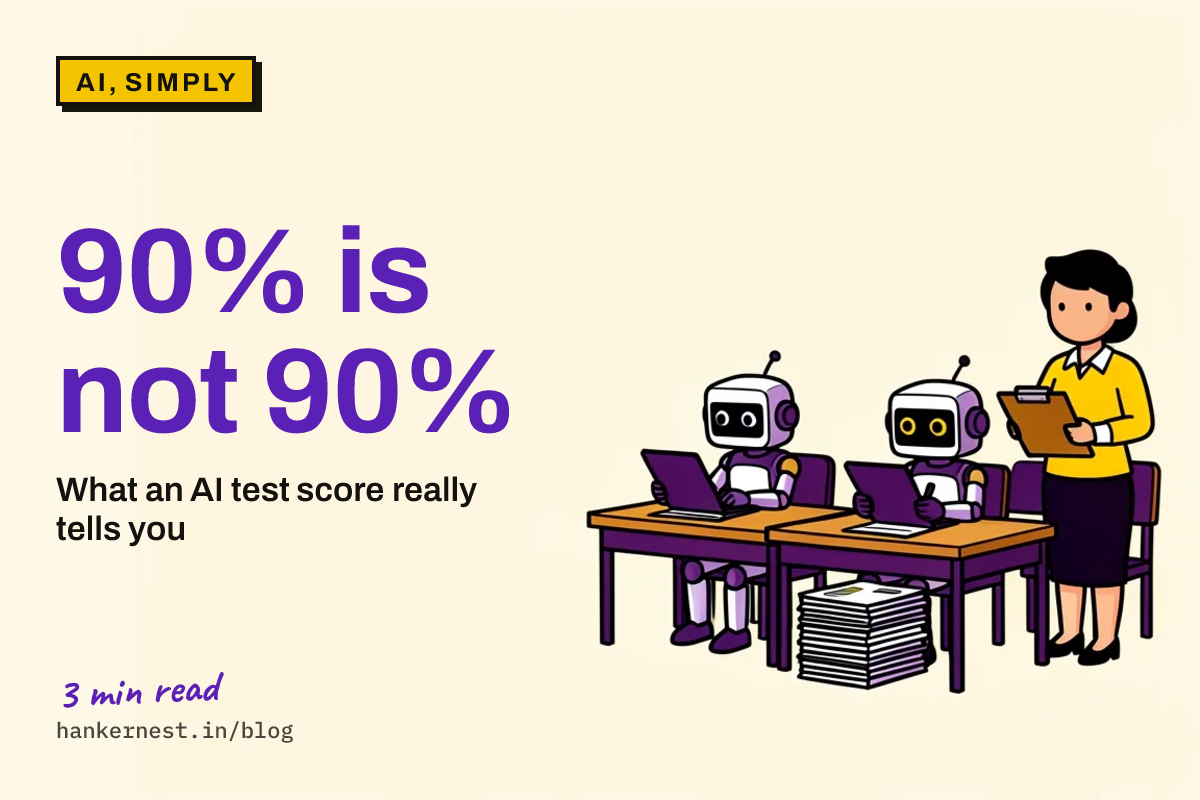
AI tests, called benchmarks, are shaky. Researcher Moritz Hardt says the order of the models still means something, and the score alone does not.
What is a benchmark?
A benchmark is a fixed set of questions that many AI models answer. The score lets people compare them.
Moritz Hardt (a computer scientist at the Max Planck Institute for Intelligent Systems) says the idea is old. In an interview published on 16 October 2026, he says the first one was in 1959. It tested how well machines read digits and letters on punch cards.
Why can’t we trust the score?
Hardt says a small change to the test can move the score a lot. His example: a model might get 90% on one set of questions and 73% on a slightly different set. Which number is the truth?
Another problem: AI makers can practise on the test. The questions are often public. A model can be trained on questions like them, then look better than it is. Hardt uses a slang word for this, “benchmaxxed”.
A score by itself
- Changes with small changes to the test
- Can be inflated by practising on the test
- Does not mean the model equals an expert
The order of models
- Often stays the same on different tests
- Says which of two models is likely better
- Gets weaker when makers hide their training data
So what can we trust?
Hardt says the order of the models has held up well. If one model beats another on one test, it usually does on others too. He says no one has a full explanation for why.
That order breaks down for chatbots, because their makers do not share what they trained on.
Hardt’s idea is to give every model the same preparation before the test. He compares it to the 1968 Olympics in Mexico City. A Kenyan runner who trained at high altitude, Kip Keino, won the 1,500 metres. The answer, Hardt says, was to let everyone train at altitude.
What’s the catch?
- This is one expert’s view, given in an interview. His fix is a proposal, not a standard that anyone uses yet.
- The 90% and 73% figures are his example of how scores can move. They are not results for named models.
Try it
This step is our idea, not Hardt’s. Next time a company says its AI scored 90% on a test, ask two questions. What did it beat? Was the test new, or older than the model?
A score tells you more as a comparison than as a grade.
Sources
- He Wants AI Benchmarking To Be a Science, Not a Dark Art, Quanta Magazine, 16 October 2026
- The Emerging Science of Machine Learning Benchmarks, Moritz Hardt, Princeton University Press
Keep reading
Three more from the notebook.
15 October 2026
An AI that fixes weather forecasts weeks ahead
A small AI add-on learns the mistakes of big weather models and corrects them. It won a global contest for forecasts two to six weeks out.Read it13 October 2026
Ten minutes of AI answers can make you give up sooner
A study of 1,222 adults found that a short session with an AI that gives answers left people solving less and skipping more once it was gone.Read it10 October 2026
Does AI help you learn, or just finish the job?
A three-month trial gave lawyers an AI drafting helper. Their work got better. Their own skill grew only for the experienced ones.Read it
Beyond the notebook
This is what we do in schools.
A year-long programme for classes 6 to 12. Creativity, taught as a skill, inside the classroom you already have, led by your teachers.