Hatch · the Arduino editor built for classrooms

Blocks in. Real hardware out.

Students drag blocks. The board runs on screen first. When a real board reaches the desk, the same program goes onto it in one click.

Runs in Chrome or Edge with a school account. The desktop edition comes with the Composite Skill Lab programme.

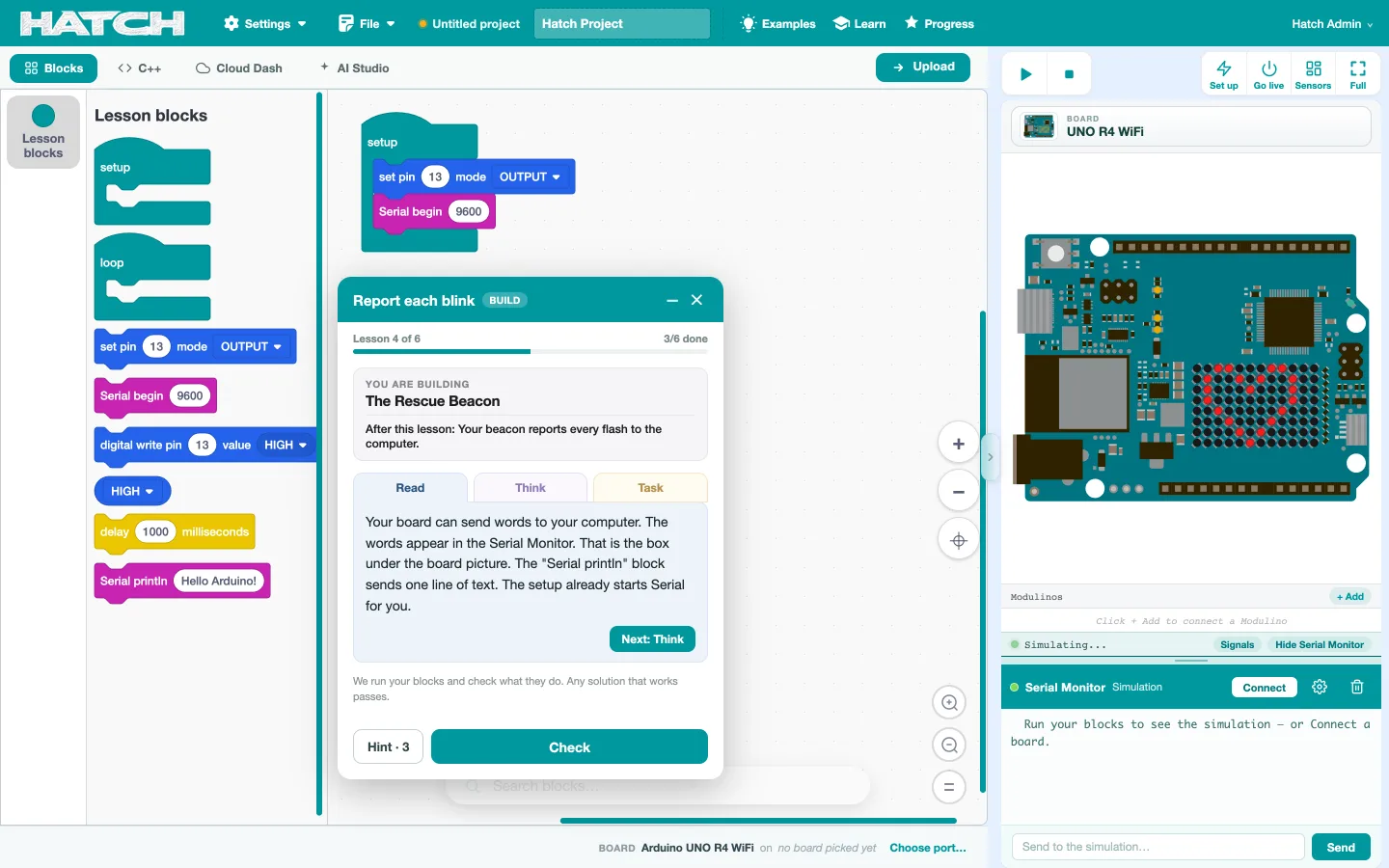
Hatch in the browser: a lesson panel titled Report each blink sits over a blocks workspace, with a drawn Arduino UNO R4 WiFi running on the right.
Lesson 4 of the Rescue Beacon track, in the browser edition.
Tracks
48
Lessons
368
Boards
UNO R4 WiFi, UNO Q
Runs
Browser, macOS, Windows

Think Inside the Box - Try, Fail, Fix, Learn - Educators before equipment - Fit before ambition - Hardware is the reward - Creativity as a skill - Kept while it happens

Blocks that write real code

The blocks say what the code says.

The blocks carry real vocabulary: pinMode, delay, Serial.println. Scratch's wait 1 seconds and forever are not here, because a student who learns those has to unlearn them later.

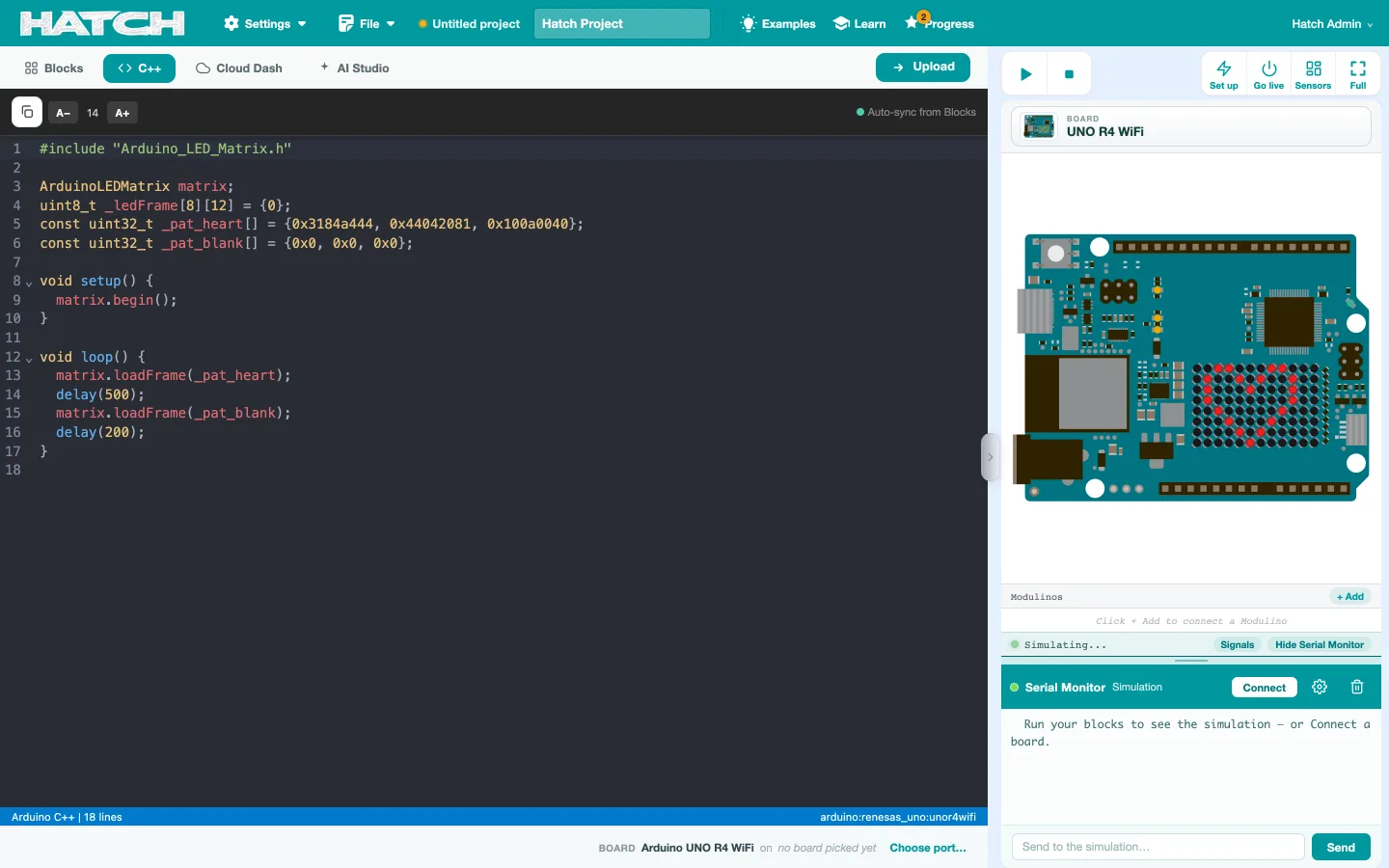
One tab over, the C++ the blocks generate. A student reads it long before they write it, and on the day they start typing, nothing about it is unfamiliar.

  1. set pin 13 mode OUTPUTpinMode(13, OUTPUT);
  2. delay 500 millisecondsdelay(500);
  3. Serial println readySerial.println("ready");
The C++ tab in Hatch showing the eighteen lines generated for the Pulsing Heart example, beside the drawn board.
The C++ tab. Eighteen lines, generated from the Pulsing Heart blocks.
The drawn Arduino UNO R4 WiFi in Hatch's simulator, its LED matrix showing a heart that switches on and off.
Pulsing Heart, running on the drawn board. Sixteen frames of the simulator, not a drawing.

A board on screen

Hardware is the reward, not the prerequisite.

A class of thirty rarely has thirty boards. Hatch draws the board and runs the student's program on it. The LED lights, the buzzer sounds, the matrix draws a heart. Everyone works in the same lesson at the same time, whether or not a board reaches their desk that day.

When a board is there, the same program uploads to it in one click.

one board on the table, thirty in the lesson

Sensors that plug in

Seven Modulinos, on screen before they are on the desk.

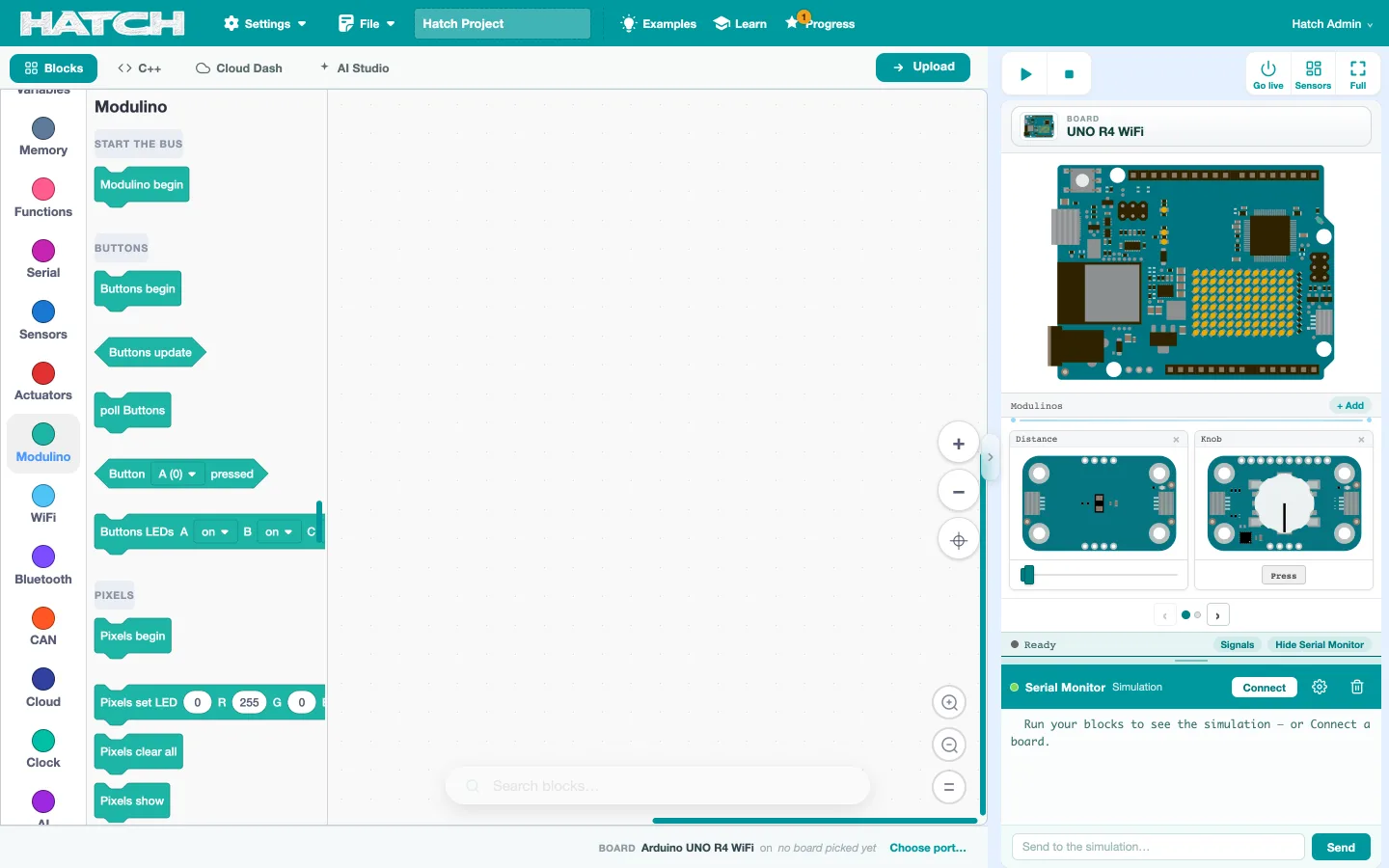
Arduino's Modulinos are small sensor and output boards that plug into the UNO with one cable: Buttons, Buzzer, Distance, Knob, Movement, Pixels and Thermo. Hatch draws each one you add and lets you drive it by hand. Slide the distance. Turn the knob. Press the button.

Each Modulino has its own blocks, so a student can write for a sensor the school has not bought yet, and know it works before it arrives.

Hatch with two Modulinos, Distance and Knob, drawn under the board and each with its own control, and the Modulino block palette open on the left.
A Distance and a Knob Modulino, added to the simulator, with the Modulino blocks open.

A course that marks itself

368 lessons, and the computer marks them.

Each track builds one named project over six lessons: the Rescue Beacon, the Fever Checker, the Smart Night Light. Every lesson has three tabs, Read, Think, Task, and a Check button.

Check runs the student's program and looks at what it actually did. Any working solution passes. There is no hidden right answer to guess at.

Progress follows the learner. A lesson finished on one laptop is finished on the next one they sign into.

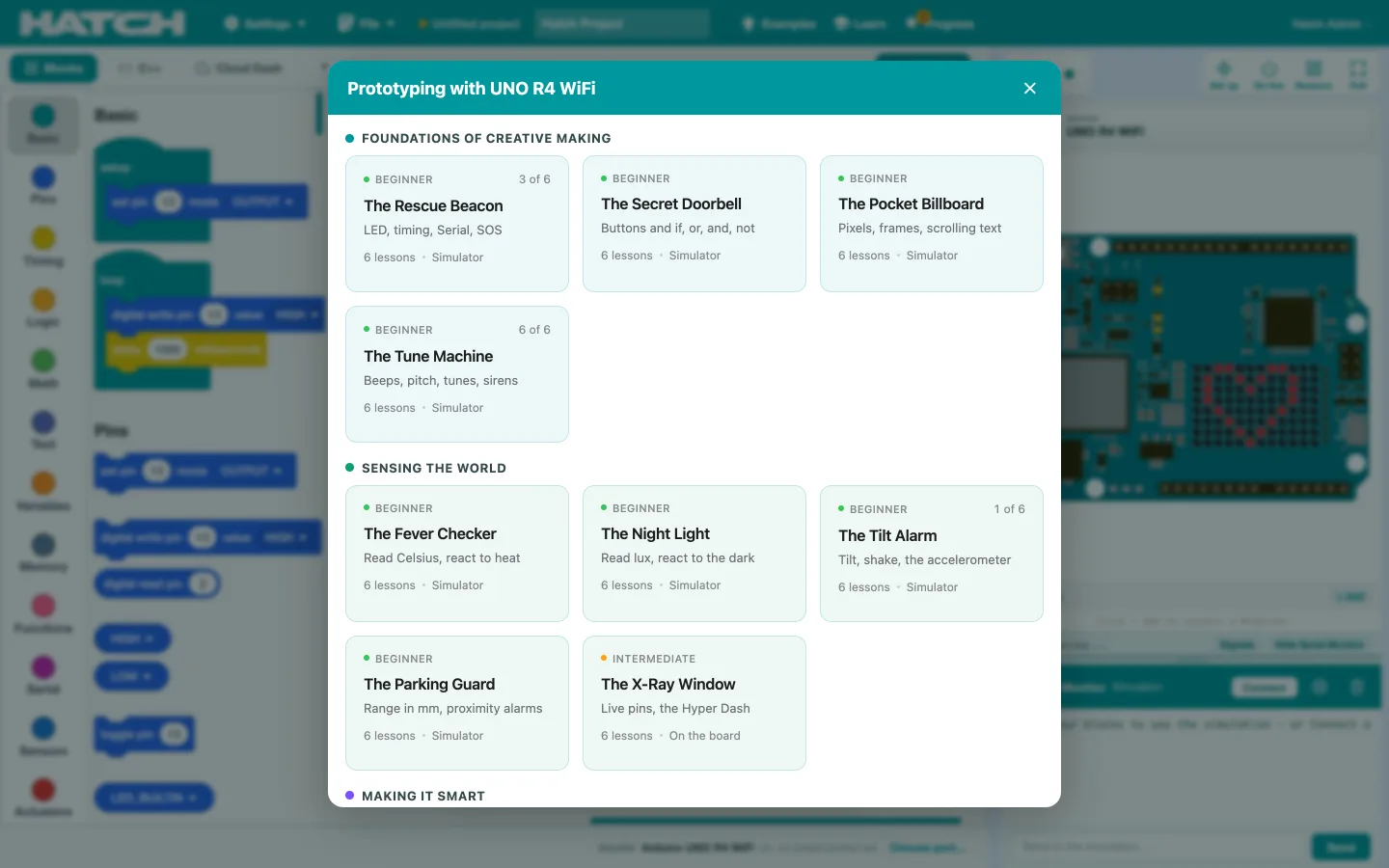
The Prototyping with UNO R4 WiFi course in Hatch: tracks laid out in sections, each card naming a project, its level and six lessons.
The R4 course. Thirty tracks in five sections, each card one project.
  • Prototyping and IoT with the UNO R4 WiFi

    30 tracks 180 lessons

    Browser and desktop

    From the Rescue Beacon to a weather station, and a project of your own.

    1. Foundations of Creative Making
    2. Sensing the World
    3. Making It Smart
    4. Talking and Connecting
    5. Building Real Things
  • Edge AI with the UNO Q

    18 tracks 188 lessons

    Desktop edition

    From the two cores and the bridge between them to TinyML, computer vision, on-device language models and ROS2.

    1. Foundations
    2. Connected
    3. Intelligence
    4. Systems
    5. Build and ship
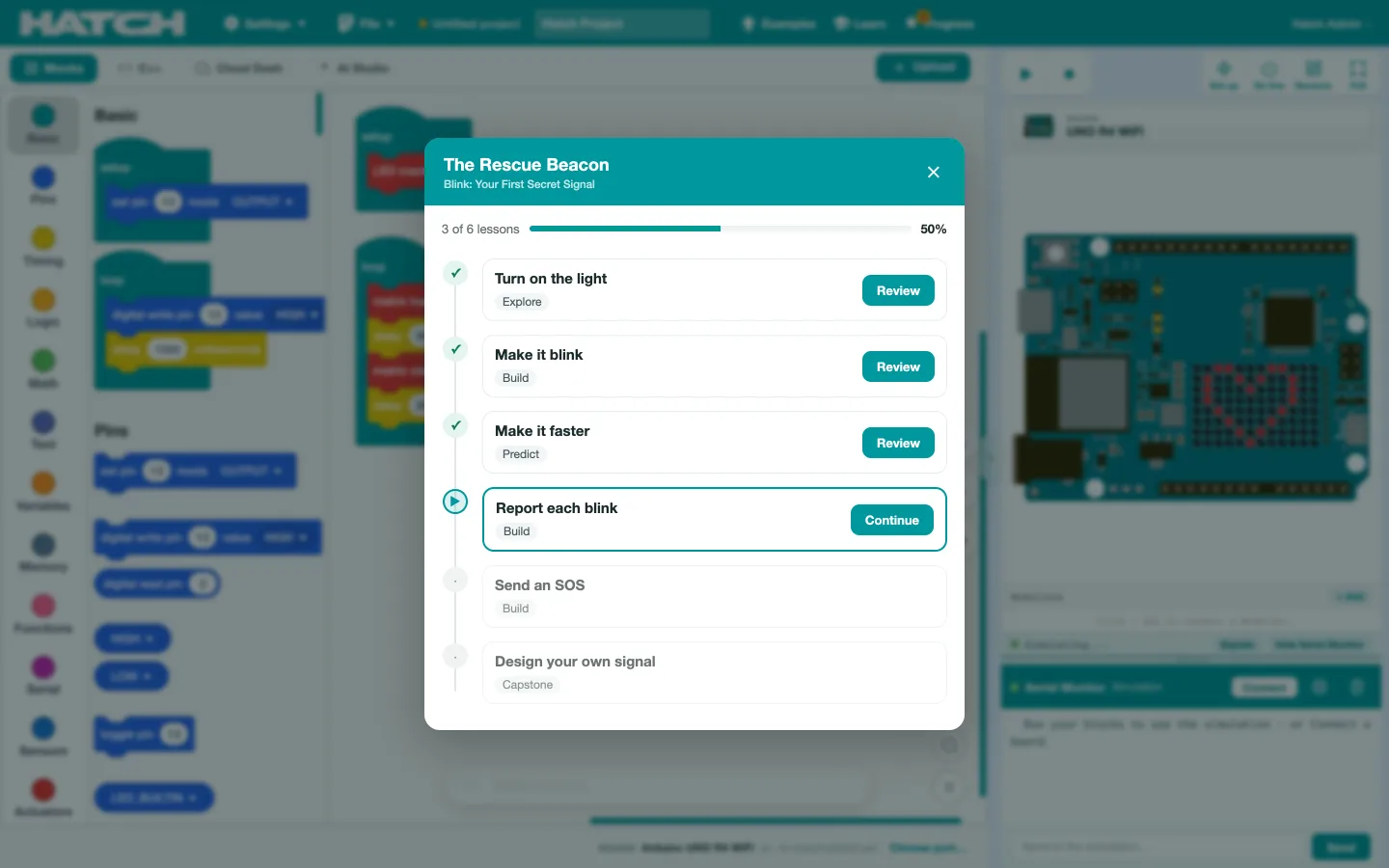
The Rescue Beacon track: six lessons listed with three ticked and the fourth ready to continue.
One track: six lessons, three done.
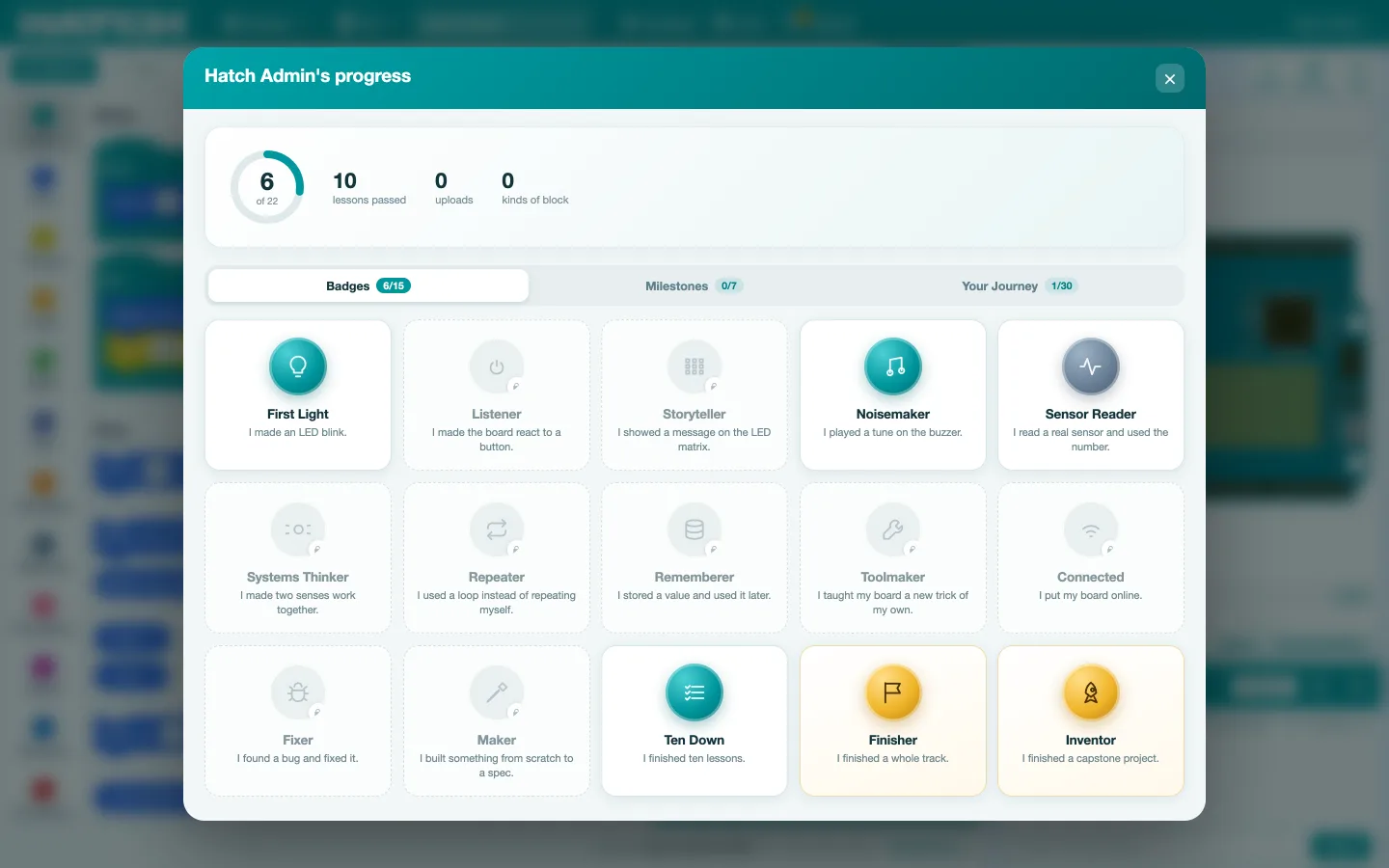
A student's progress panel in Hatch: lessons passed, and fifteen badges such as First Light, Noisemaker and Finisher, six of them earned.
Fifteen badges, each for a thing the student actually did.

AI Studio

Teach the AI, then use it as a block.

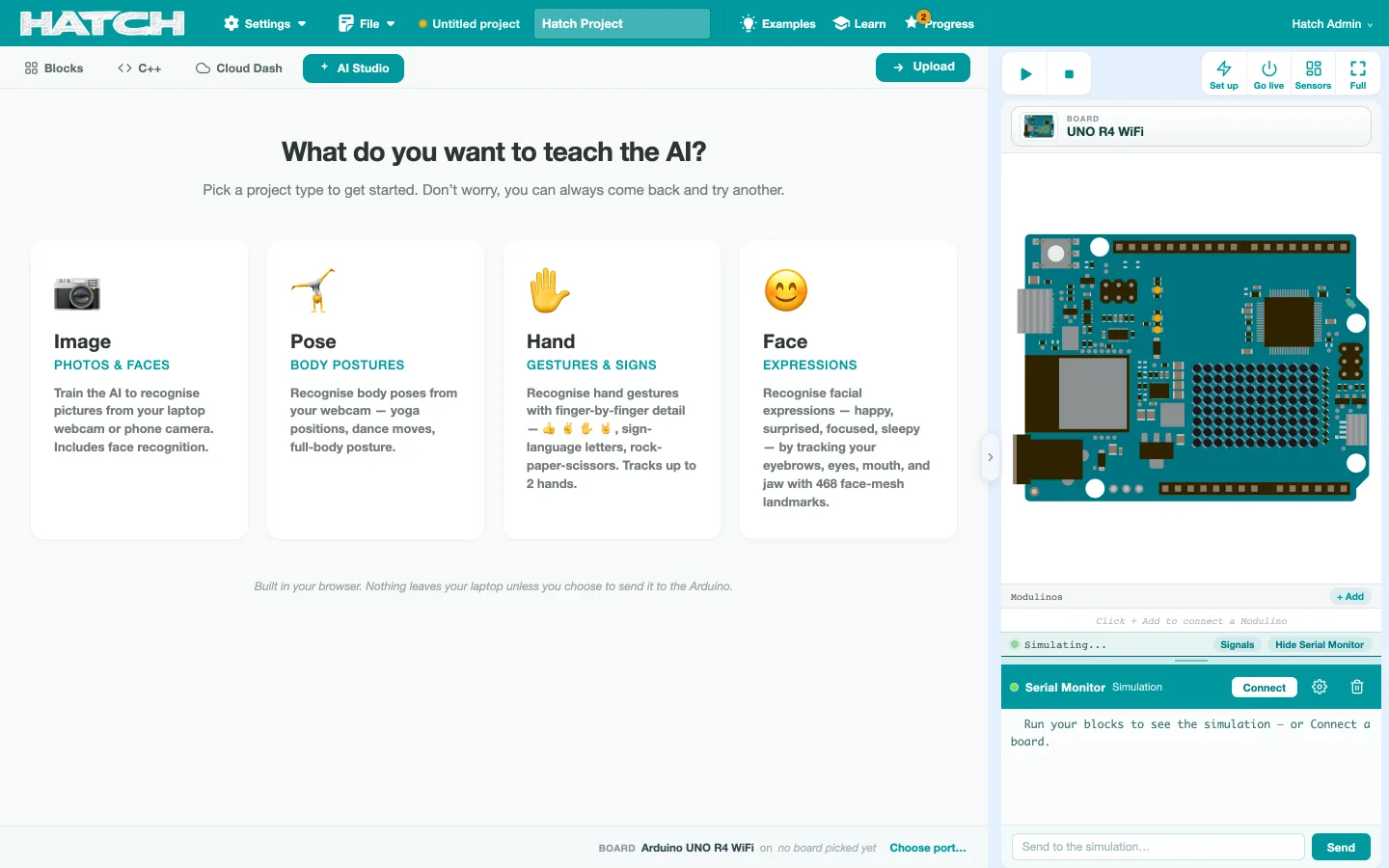
A student trains a model on their own images, poses, hand gestures or faces, using the laptop's camera, in the browser. The model becomes a block, and the block drives the board.

Nothing leaves the laptop unless the student chooses to send it to the Arduino.

AI Studio in Hatch asking What do you want to teach the AI, with four project types: Image, Pose, Hand and Face.
AI Studio. Four kinds of model, trained in the browser.
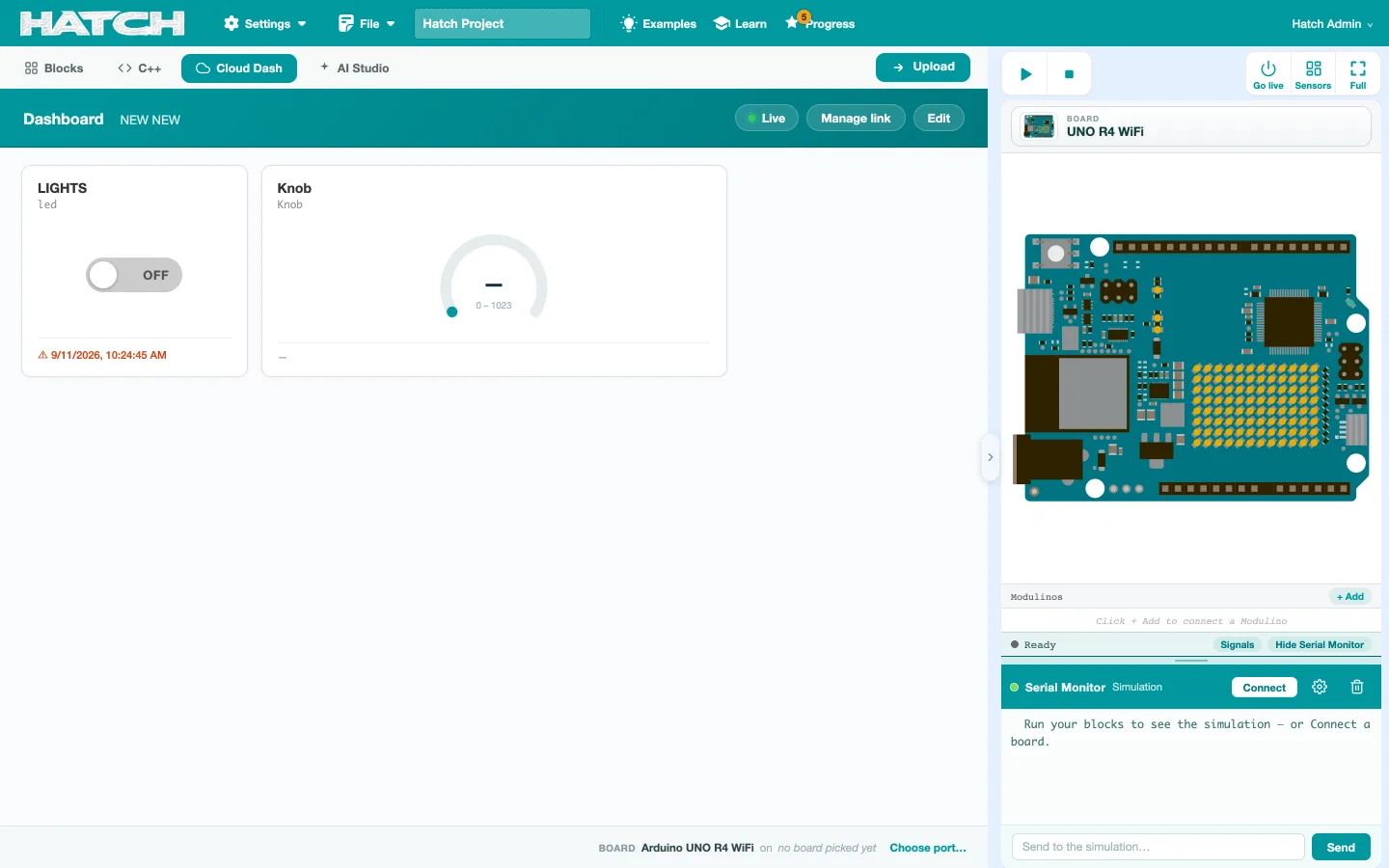
Cloud Dash in Hatch: a dashboard with a Lights switch and a Knob gauge, marked Live, with Manage link and Edit buttons.
A two-widget dashboard: a switch that drives an LED, a gauge that shows a knob.

A dashboard you can share

The board's numbers, on any phone.

Cloud Dash is a no-code dashboard for the values a board is reading and the things it can switch. A student drops in a switch or a gauge, points it at a block, and the dashboard goes live.

It shares by link and PIN, so a parent can watch the classroom's plant sensor from home without an account.

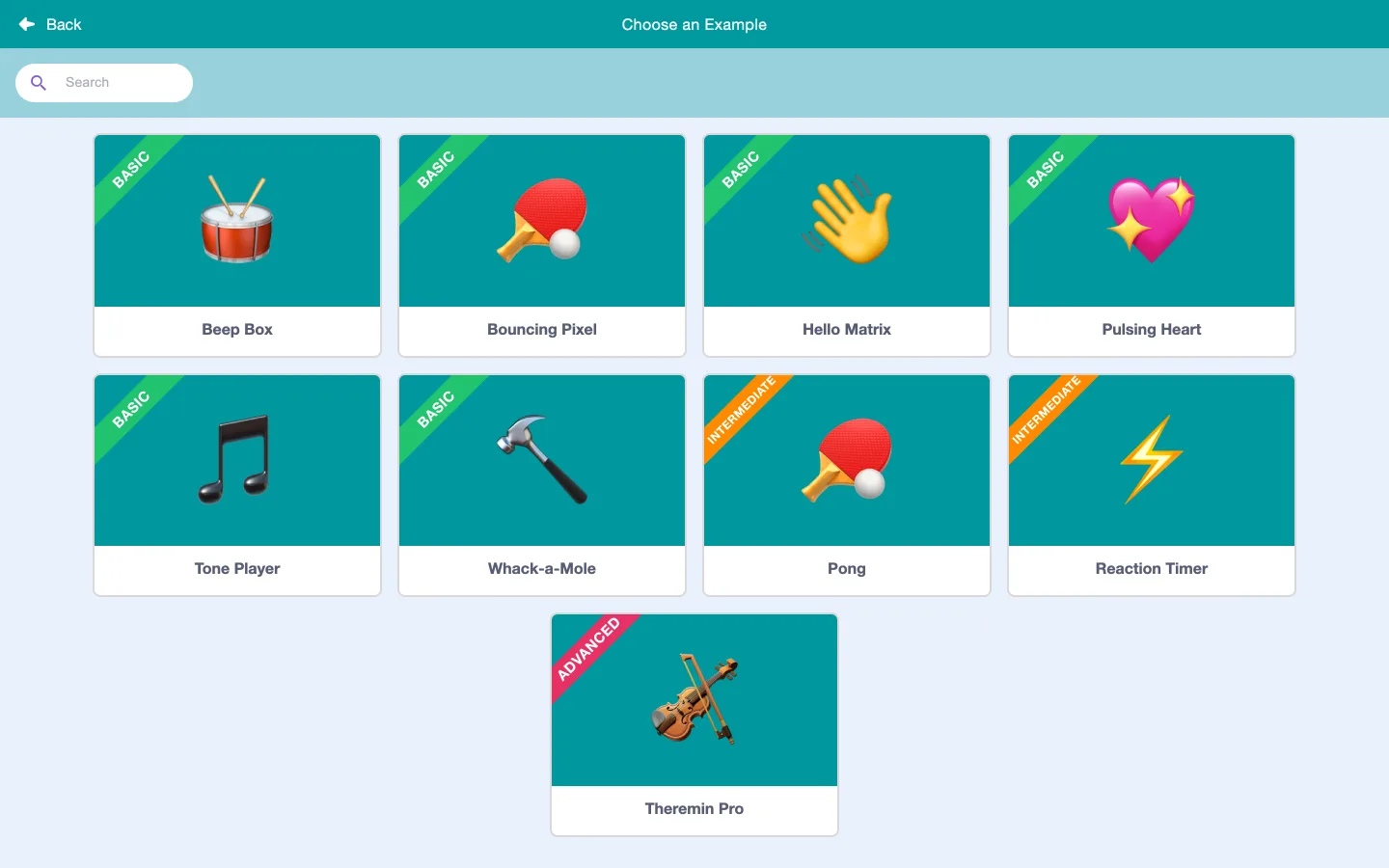
Hatch's example gallery: nine projects from Beep Box to Theremin Pro, each labelled basic, intermediate or advanced.
Nine examples, from Beep Box to Theremin Pro.

Examples

Something that works, to take apart.

Nine finished projects open with one click, from a Beep Box to a Theremin. A student runs one, watches the board do it, then pulls it apart to see why. Every example works in the simulator.

For teachers

A room you can see.

A teacher sees which boards in the room are online, opens a student's project read-only, and sends a suggested fix. The student chooses whether to apply it. Nothing is overwritten by an adult.

Accounts come from a roster the school uploads. Each student signs in with a username and a PIN, and their progress follows them from machine to machine, so a reset laptop no longer loses a term's work.

What does not exist yet: class reports, rankings, and a dashboard you could put on a wall. We would rather say so here than have you find out in the lab.

Two editions

In the browser, or on the desk.

In the browser

School edition

  • Opens at hatch.hankernest.in with a school account
  • The Arduino UNO R4 WiFi, and only that board
  • The simulator, the full R4 course, AI Studio, examples
  • Uploads to the board from Chrome or Edge
  • Compiles on our server, so it needs internet

On the desktop

Comes with the Composite Skill Lab programme

  • macOS, and available for Windows
  • The UNO R4 WiFi and the UNO Q, with the Edge AI course
  • Arduino cores bundled: the first compile works with no internet
  • The teacher's view of the room
  • A 14-day trial, then the school plan

FAQ

Honest answers.

Can we use Hatch in a browser?

Yes, with a school account, in Chrome or Edge. The browser edition runs the simulator, the full R4 course and AI Studio, and it uploads to an Arduino UNO R4 WiFi over the browser's own serial connection. Other browsers can run everything except the upload.

Which boards does it support?

The browser edition is the school edition, and it is locked to the Arduino UNO R4 WiFi on purpose. One board, learned properly, beats five half-learned. The desktop edition adds the Arduino UNO Q and its Edge AI course.

Do we need internet in the lab?

The browser edition does, since compiling happens on our server. The desktop edition ships with the Arduino cores bundled, so the first compile works with no internet. Internet is needed for cloud features and updates.

How do students get accounts?

From us, or from a roster the school uploads and we approve. There is no public sign-up, on purpose. A student signs in with a username and a PIN, and their lesson progress follows them to any machine.

Is there a teacher dashboard?

Not as a product, and we would rather say so. Today a teacher sees which boards in the room are online, can open a student's project read-only, and can send a suggested fix that the student chooses whether to apply. Class reports are the next piece of work.

What does Hatch cost?

The desktop edition comes with the Composite Skill Lab programme. Browser accounts are priced per school with the programme they sit inside, so we quote on a call rather than publish a number we would have to qualify.

Is this Scratch?

It is built on Scratch's editor, which is open source, and then changed substantially for hardware. It is not made by or endorsed by the Scratch Foundation or MIT.
Get it

Open it, or ask us for accounts.