Hardik's Notes · AI, simply
Ten minutes of AI answers can make you give up sooner
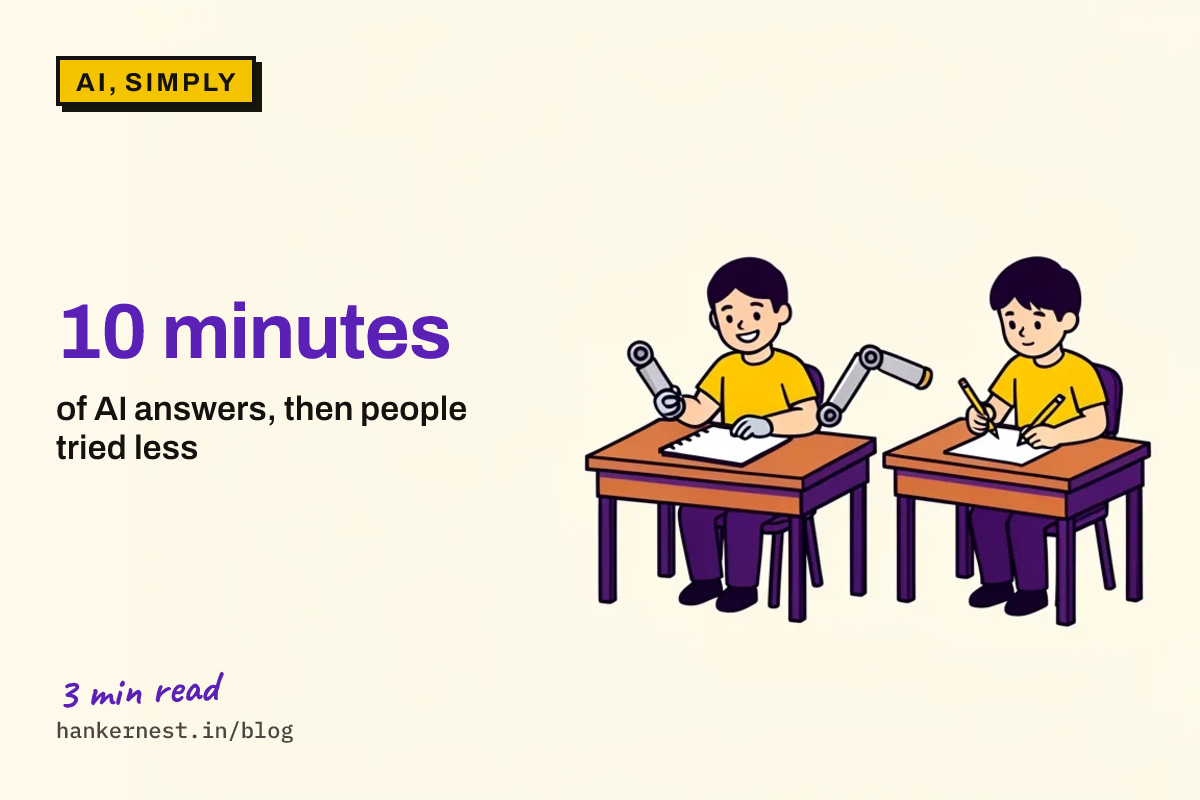
A study of 1,222 adults found that a short session with an AI that gives answers left people solving less and skipping more once it was gone.
What did they test?
A team from Carnegie Mellon, Berkeley, Oxford, MIT and UCLA ran three online experiments. They recruited 1,222 adults in the United States. The paper was first posted on 6 April 2026 and was updated on 3 October 2026 for the COLM 2026 conference.
People were split by chance into two groups. One group solved problems with an AI helper (GPT-5) in a side panel. That AI was given the right answers, so it could reply at once. The other group worked alone.
Then the AI was removed without warning. Everyone did three more problems alone. Skipping a problem was allowed, with no penalty.
What happened?
With the AI helper
- Solved more problems while it was there
- Solved fewer once it was gone
- Skipped more in two of the three experiments
Working alone all the way
- Solved fewer while practising
- Solved more on the final three
- Skipped less in the same two experiments
In the reading test, the AI group solved 76 of every 100 final questions. The group that worked alone solved 89. The AI group skipped 8 of every 100. The other group skipped 1.
In the larger fractions test, the AI group solved 71 of every 100 and the other group 77. The skipping gap there was too small to count as real. The authors say so.
Does it matter how you ask?
In the larger fractions test, the researchers also asked the AI group how they had used it. This part was not by chance, so it shows a pattern, not a cause.
61%
said they mainly asked the AI for answers
Those people solved 65 of every 100 final problems. People who asked for hints or explanations solved 76. People who barely used the AI solved 89. The group with no AI at all solved 77.
The authors suspect that quick answers make hard work feel slower and harder afterwards. That is their explanation. They did not test it directly.
What’s the catch?
- The people were adults, not school students.
- The AI was only there for about ten minutes. Nobody knows how long the effect lasts, or if it adds up over months.
- People were tested right after the AI was removed. Nobody checked a day later.
- This AI gave full answers on request. A tutor that only gives hints was not tested.
Try it
This is our idea, not the paper’s. Next time you study with a chatbot, do the first attempt alone, even if it is wrong. Then ask for a hint, not the answer. Afterwards, close the chat and try one similar problem without it.
If you feel like skipping that last one, you have just seen the effect.
Sources
- AI Assistance Reduces Persistence and Hurts Independent Performance, Liu, Christian, Dumbalska, Bakker and Dubey, COLM 2026, arXiv version of 3 October 2026
Keep reading
Three more from the notebook.
10 October 2026
Does AI help you learn, or just finish the job?
A three-month trial gave lawyers an AI drafting helper. Their work got better. Their own skill grew only for the experienced ones.Read it8 October 2026
Every AI chip on one chart: from 2 watts to a data centre
MIT Lincoln Laboratory plots AI chips by speed and power. The chart shows why a camera and a data centre need different chips.Read it8 October 2026
How Google steers an AI image maker without rebuilding it
Ask for a lizard in sunglasses and you may get a lizard with none. Google Research built a small add-on that steers the model.Read it
Beyond the notebook
This is what we do in schools.
A year-long programme for classes 6 to 12. Creativity, taught as a skill, inside the classroom you already have, led by your teachers.