Hardik's Notes · AI, simply
Four small AI machines, all built on one board
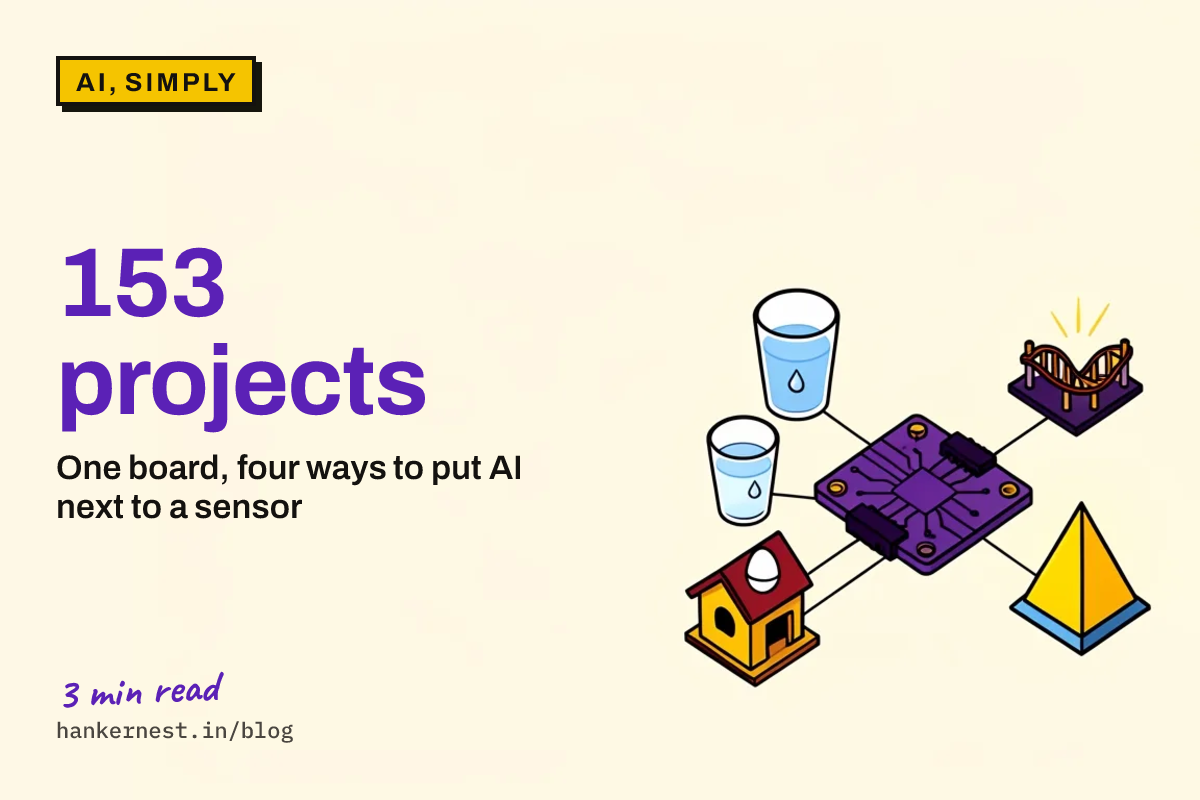
Arduino named the winners of a contest for its UNO Q board. Four of them use AI to sense water, eggs, rides and light.
What is AI on a small board?
Most chatbots run on faraway computers. Your question travels there and the answer travels back.
AI on a small board is different. The model (a program that learned a pattern from examples) sits on the board beside the sensor. It looks at the readings as they arrive. People call this edge AI, because it happens at the edge of the network, where the sensor is.
What did people build?
Arduino, Qualcomm Technologies, Edge Impulse and Hackster ran the Invent the Future contest. All entries used the Arduino UNO Q board and the Arduino App Lab software. Arduino says there were 153 final project submissions.
Sensor, then a pattern
- Smart Water Guardian AI: measures temperature, pH, turbidity and dissolved solids, and looks for readings that point to poor water
- Smart Coop 2.0: uses local AI models to spot eggs and possible predators
- Edge-AI Spectrophotometer: runs a model that finds deviations from known baselines in light readings
Sensor, then a score
- RCT IRL: a board, a motion sensor and a battery in a fanny pack
- Three Edge Impulse models score a roller coaster ride after it ends
- The scores are named Excitement, Intensity and Nausea
- Arduino says it also reports ride time and the highest g-forces
The first column finds something unusual. The second turns movement into a number a person can read. Both start with a sensor.
What stands out?
HaloSense V1 asks a different question. It buzzes 13 small motors on a headset, to see if a wearer can learn to read the buzzing as information over time. Arduino says that is the aim of the project.
Curie, a small desktop robot, goes the other way. Arduino says it connects to a cloud service called Groq to run open-source AI models. So not every winner keeps its AI on the board. It is worth asking, for each idea: what must stay local, and what can go to the cloud?
What’s the catch?
- This is a contest report, written by the board’s maker. Arduino says what each project is designed to do. It does not give test results.
- We read Arduino’s post. We did not read the project pages or run any of the projects.
Try it
This step is our idea. On paper, pick one sensor you could buy: a light sensor, a temperature sensor or a motion sensor. Write down five readings a day. Mark which ones are normal and which one is odd.
Then write the rule you used to decide. That rule is what a small model learns from many examples.
Sources
- Inside the winning Arduino UNO Q projects from Hackster’s Invent the Future competition, Arduino blog, 29 October 2026
Keep reading
Three more from the notebook.
30 October 2026
A tiny chip that dreams up its own video games
A maker runs two small neural networks on a Raspberry Pi Pico 2 W. One invents each game frame. The other plays it.Read it28 October 2026
Why chatbots stop learning, and a sleep-based fix
A chatbot is frozen after training. Google researchers test letting it 'sleep' to store new facts without losing old ones.Read it24 October 2026
Why chatbots make things up: AI was built to surprise
Early AI builders added randomness on purpose, to copy human creativity. A historian says that is where made-up answers come from.Read it
Beyond the notebook
This is what we do in schools.
A year-long programme for classes 6 to 12. Creativity, taught as a skill, inside the classroom you already have, led by your teachers.