Hardik's Notes · AI, simply
Why chatbots make things up: AI was built to surprise
Early AI builders added randomness on purpose, to copy human creativity. A historian says that is where made-up answers come from.
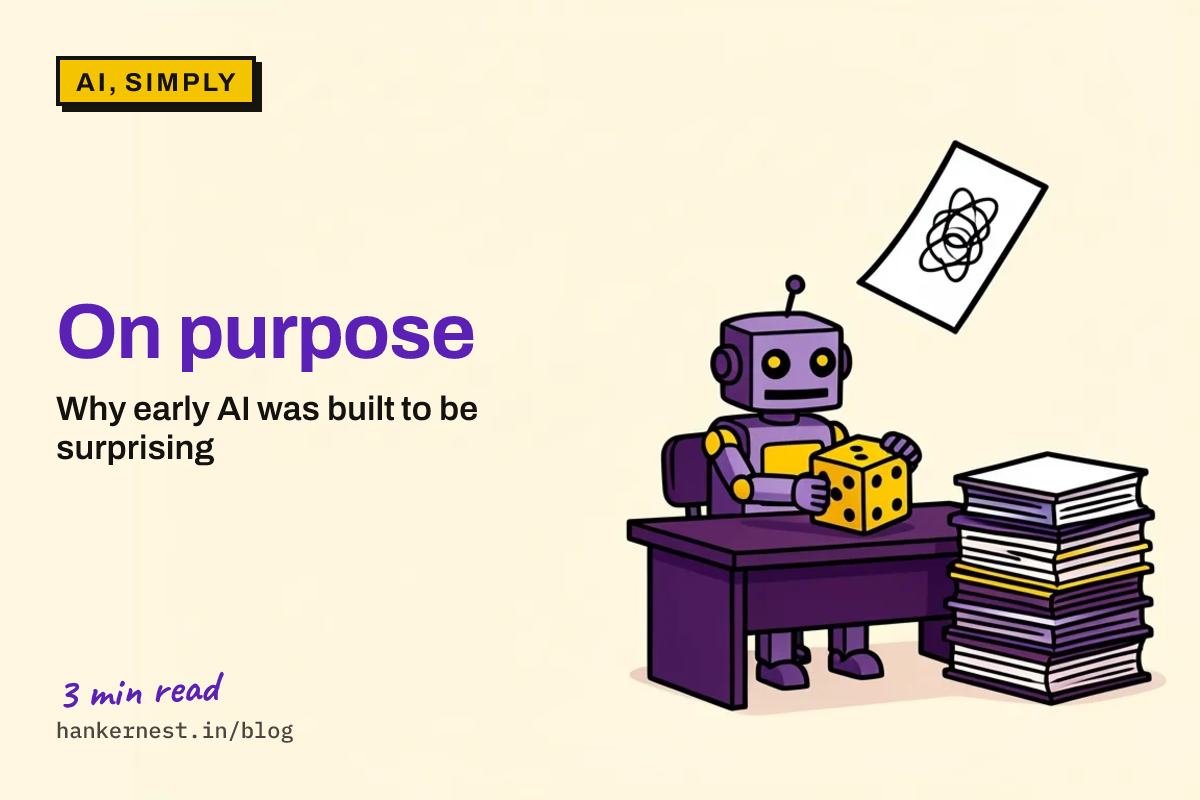
Why would anyone make a computer unpredictable?
Computers are good at exact answers. In the early 1950s, some engineers wanted something else.
In an interview published by MIT News on 23 October 2026, Benjamin Lindquist (an assistant professor in MIT’s History Section) explains why. He says many people then believed chance plays a part in discovery and creativity. If a machine only follows fixed steps, it can never leap to a new idea.
His example is John Pierce, an engineer at Bell Labs. Pierce thought maths could add a burst of the unexpected to art and break clichés.
What did that have to do with neural networks?
Lindquist says one way to add irregularity was through artificial neural networks. Many early ones were built by psychologists. They hoped to model the brain, mistakes included.
He says the early fans valued these systems for the opposite reason from ours. Today we want chatbots to be right. They wanted a system that sometimes gave an answer nobody expected.
Early AI builders wanted
- Answers that sometimes surprise
- A model of how brains make useful mistakes
- Chance as a source of new ideas
Chatbot users want
- Answers that are correct
- The same question, a steady answer
- Nothing made up
Where do made-up answers come from, then?
In his new paper, Lindquist traces the origin of AI hallucinations to this early work. He says there is a link between creative answers and wrong ones.
He also says companies now “sand down” the strangeness for legal and money reasons. In his words, it is still there at the core, but largely held back.
What’s the catch?
- This is one historian’s reading, given in an interview. We read the interview, not the paper.
- Lindquist does not say every chatbot error is caused by deliberate randomness. He says the history shows a trade-off.
- His lesson: push hard against surprises and you may lose something else, such as creativity.
Try it
This step is our idea, not Lindquist’s. Ask a chatbot an open question twice. Try “Give me a name for a robot that waters plants.” Then ask a factual one twice. Try “How many days are in a leap year?” Which answers changed? Which did you want to change?
You decide what you want from the machine: a surprise or a fact.
Sources
- Q&A: How AI came to model the “messy” human mind, Adam Zewe, MIT News, 23 October 2026
- The Irrational Computer: Randomness and Unreason in the History of Artificial Intelligence, Benjamin Lindquist, Past and Present (not opened in full)
Keep reading
Three more from the notebook.
21 October 2026
Build it this weekend: a reaction timer
One button, one LED and 30 lines of MicroPython on a Raspberry Pi Pico. It measures how fast you press, in milliseconds.Read it21 October 2026
Five million times faster? Read the small print
Arduino compared a 2000s chip with its newest AI board. The headline number is huge. The way they got it shows how to read any speed claim.Read it20 October 2026
Teach an AI symmetry instead of making it guess
A hospital scan AI has left-right symmetry built in, so it tells which way a head faces more reliably. What that shows about teaching AI.Read it
Beyond the notebook
This is what we do in schools.
A year-long programme for classes 6 to 12. Creativity, taught as a skill, inside the classroom you already have, led by your teachers.