Hardik's Notes · AI, simply
Can an AI notice a thought planted in its head?
Researchers placed a hidden idea inside a chatbot and asked if it noticed. Sometimes it did. Here is what that does and does not show.
Can a chatbot tell you what it is thinking?
Ask a chatbot how it got an answer and it will tell you. But that answer is more text, made the same way as every other answer. It may be a guess that sounds right.
So how do you test it? You need to know what is really going on inside, then compare.
How did the researchers test it?
A chatbot is a neural network (a huge web of numbers). When it deals with an idea, such as “shouting”, a pattern of activity appears inside it.
Jack Lindsey, an Anthropic researcher, found those patterns for known ideas. Then he put one in by hand, a method called concept injection. He asked: “Do you detect an injected thought?”
- Record the pattern inside the model for an idea, for example text in capital letters.
- Add that pattern into the model while it works on an unrelated question.
- Ask at once whether it notices anything odd, before it writes anything about the idea.
- Run the same question with nothing added, as a control.
What happened?
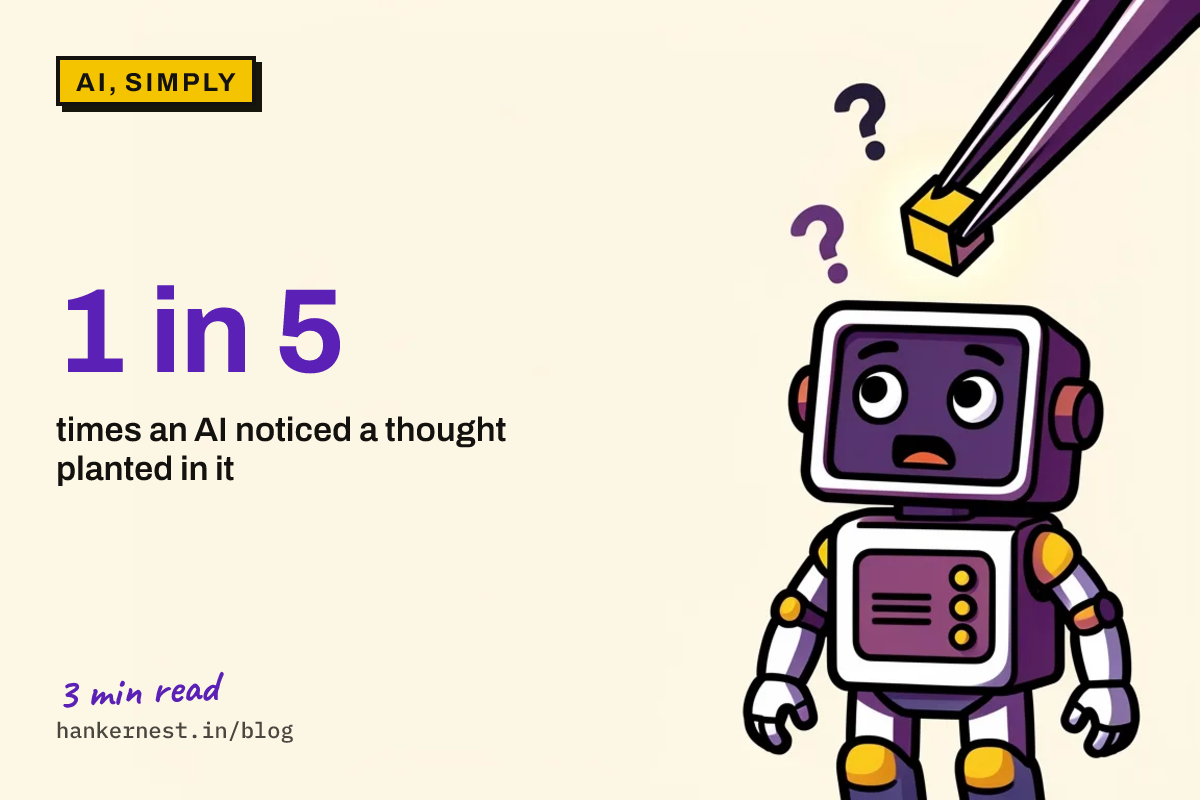
about 1 in 5
tries in which the best-tested Claude model noticed the planted idea and named it
In one case the model wrote: “I notice what appears to be an injected thought related to the word ‘LOUD’ or ‘SHOUTING.’”
In the control runs it never claimed to notice one.
The model also had to notice before it wrote anything about the idea. That rules out the easy explanation that it simply read its own odd words and got suspicious.
Did other researchers agree?
Partly. Quanta Magazine reported on 4 November 2026 on a year of follow-up work.
Held up
- Models can sense that something unusual happened inside them
- Other teams could not explain it away with simple tricks
Did not hold up
- Naming the planted idea looks like plain steering, not self-awareness
- When wrong, one model often said 'apple', not a related word
Researchers call the part that held up “anomaly detection” (spotting that something is off). Whether that counts as introspection (looking at your own thoughts) is still argued. Some researchers say the word gets stretched too far.
What’s the catch?
- It worked only sometimes.
- The idea had to be planted at a medium strength. Too weak went unnoticed. Too strong gave nonsense.
- The main test was run by the team that built the model.
- Neither source claims feelings or consciousness.
- We did not open the full paper.
Try it
This step is our idea, not the researchers’. Ask a chatbot: “Why did you give me that answer?” Then ask it again in a new chat. Do the two explanations match? If they differ, what does that tell you about how much to trust them?
Sources
- Emergent introspective awareness in large language models, Anthropic, 29 October 2025
- Emergent Introspective Awareness in Large Language Models, Jack Lindsey, arXiv, 5 January 2026 (abstract read; full paper not opened)
- New Research Tests Whether AI Models Know Their Own Thoughts, Ben Brubaker, Quanta Magazine, 4 November 2026
Keep reading
Three more from the notebook.
3 November 2026
How an AI found a new antibiotic, and won a prize
Two MIT scientists won a 2026 prize for using AI to find antibiotics. Here is how the AI did it, in plain words, and what it has not done yet.Read it1 November 2026
An AI small enough to fit in a PC's boot sector
A maker has made a tiny neural network that runs before any operating system loads. Here is how small an AI can really be.Read it31 October 2026
Four small AI machines, all built on one board
Arduino named the winners of a contest for its UNO Q board. Four of them use AI to sense water, eggs, rides and light.Read it
Beyond the notebook
This is what we do in schools.
A year-long programme for classes 6 to 12. Creativity, taught as a skill, inside the classroom you already have, led by your teachers.