A warning before the list
Search “skills that survive AI” and you will drown in confident lists. Creativity! Emotional intelligence! Critical thinking! They all sound right, they all feel reassuring, and almost none of them come with evidence. They are vibes formatted as advice.
So before adding to the pile, a promise: every claim in this post is tied to something checkable, either real labour-market data or published research. Where something is a projection rather than a measurement, it is labelled as one. And where the honest answer is “we don’t know,” it says so.
That matters, because the stakes are real. Students are making subject choices, and schools are making curriculum choices, based on guesses about a future nobody can see clearly. The least we can do is separate the guesses from the evidence.
First, the uncomfortable truth about predictions
Here is the thing the confident lists never admit: we are bad at predicting which jobs disappear.
For a decade, the standard prediction was that AI would take the routine, manual, blue-collar jobs first, and that “knowledge work” was safe. The opposite happened. The current wave of AI is best at exactly the white-collar tasks, writing, summarising, coding, analysis, that were supposed to be protected, while a plumber’s job remains almost untouched. The experts were confidently, measurably wrong.
Keep that in mind as you read any forecast, including the ones below. They are the best evidence we have, not prophecy. Treat them as a compass, not a map.
What the labour-market data actually says
The most credible large-scale source on this is the World Economic Forum’s Future of Jobs Report 2025, which surveyed over 1,000 employers covering more than 14 million workers across 55 economies. It is a survey of what employers say they expect, which is not the same as what will happen, but it is the closest thing to hard data we have.
Two findings are worth holding onto.
First, employers expect that 39% of workers’ core skills will change or become outdated by 2030. Notably, that figure is down from 44% in the 2023 edition, which the report attributes to better upskilling, not less disruption. The ground is moving, but it is moving slightly slower than the panic suggested.
Second, and more useful, the report ranks which skills are rising in importance fastest. The top of the list is not what the “creativity will save you” crowd assumes. The fastest-rising skills are, in order, AI and big data, networks and cybersecurity, and technological literacy. Hard technical skills. Then, rising alongside them, come the human ones: creative thinking, resilience and flexibility, curiosity and lifelong learning, and analytical thinking.
This is the first evidence-based correction to the usual story. It is not “technical skills are dying, human skills will save you.” It is “technical fluency and human skills are both rising, together.” The student who can use the new tools and think well is the one the data points to. Not one or the other.
The skill the data quietly puts at the centre
Look closely at that list and one item connects all the others: the ability to keep learning.
The WEF report singles out “curiosity and lifelong learning” as a top-rising skill, and it makes sense of everything else. If 39% of skills change by 2030, then the specific skills you have matter less than your capacity to acquire the next ones. In a stable world, you learn a trade and practise it for forty years. In this one, the half-life of a specific skill is short, so the meta-skill, learning how to learn, becomes the only durable asset.
This is not a vibe. It is the logical consequence of the disruption figure. If the content of work keeps changing, the ability to re-learn is the thing that survives the changes.
Now the part most lists ignore: AI can erode the very skills you need
Here is where the evidence gets genuinely uncomfortable, and where most “future skills” articles go quiet.
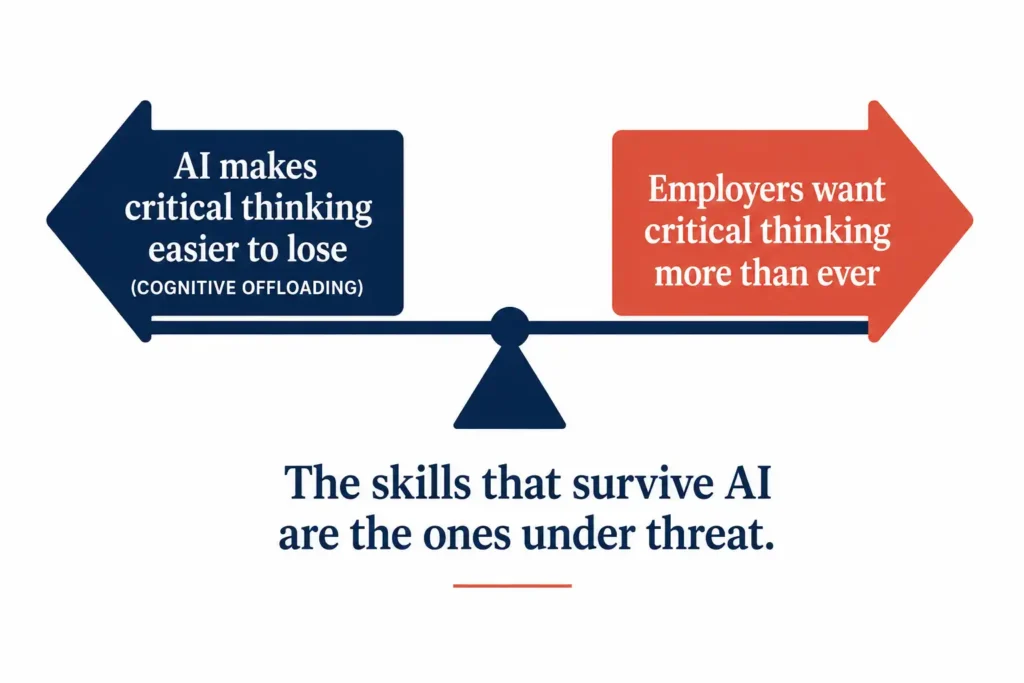
The skills everyone agrees will matter, critical thinking, analytical reasoning, independent judgment, are precisely the skills that heavy AI use appears to weaken. This is not speculation. A 2025 study by Michael Gerlich, published in the journal Societies, surveyed 666 people and found a significant negative correlation between frequent AI tool use and critical thinking ability, with the effect strongest in younger users. The mechanism is something researchers call cognitive offloading: when you hand a mental task to a tool, you stop doing the task, and the underlying ability quietly weakens, the way a muscle does when it is never used.
One study is not proof, and correlation is not causation, the people who lean hardest on AI may already have been less inclined to deep analysis. The author is careful about this, and so should we be. But the finding does not stand alone. A growing body of work points the same way: students who rely heavily on AI dialogue systems show diminished decision-making and independent analysis. The pattern is consistent enough to take seriously.
Sit with the paradox, because it is the whole point of this post. The labour market is asking for more critical thinking. The dominant tool of the age makes critical thinking easier to lose. Which means the skills that survive AI are not just valuable because employers want them. They are valuable because they are actively under threat, and the people who deliberately protect and build them will be rare.
So what actually survives? The honest list
Putting the evidence together, here is a list you can defend, with the reasoning attached to each item rather than a confident assertion.
This is the part worth saving.
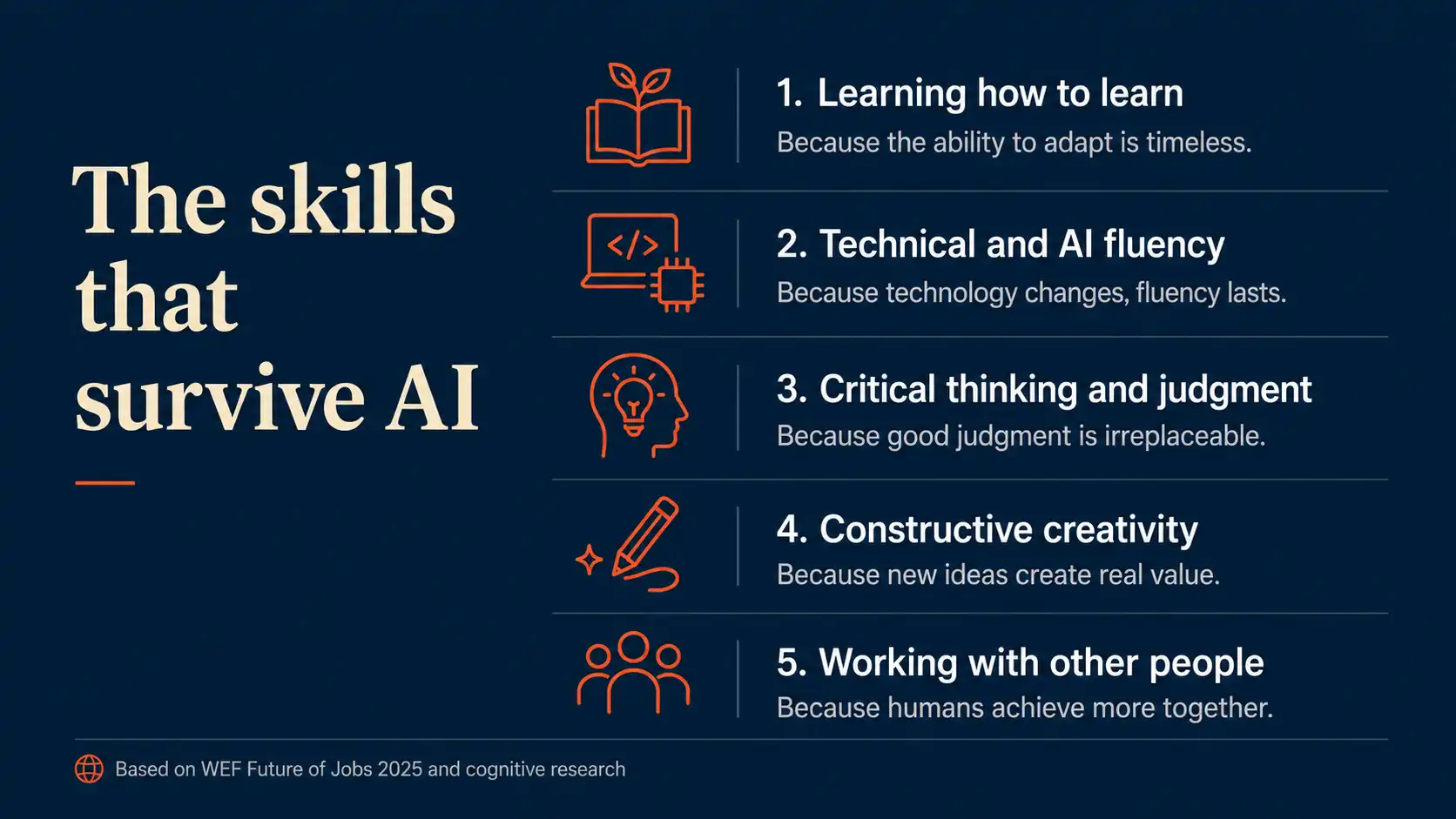
The skills the evidence supports, and why
- Learning how to learn. Because 39% of skills change by 2030 (WEF). The meta-skill outlives every specific one.
- Technical and AI fluency. Because the fastest-rising skills in the data are technological, not in spite of AI but because of it. You must be able to use the tools.
- Critical thinking and judgment. Because employers rank it high and because the evidence shows it erodes under heavy AI use. Valuable and endangered at once.
- Creativity, the constructive kind. Because asking the question nobody set, and deciding what is worth making, is the work AI does least well. (And because, as the research shows, creativity is a buildable skill, not a fixed talent.)
- Working with other people. Collaboration, communication, and resilience rank consistently high across every edition of the data, and they are the hardest for any tool to replicate.
Notice what is not on the list: any specific software, any specific coding language, any specific “hot job.” Those are bets. The five above are not bets. They are the capabilities that the data, the research, and basic logic all point toward at once.
What this means for a student, and a school
If you are a student, the takeaway is not “learn to code” or “don’t bother, AI will do it.” It is both halves of a sentence: become fluent with the tools, and deliberately protect the thinking the tools tempt you to outsource. Use AI to draft, then force yourself to critique what it gave you. Use it to get the answer, then make yourself reconstruct why the answer is right. The student who does this builds AI fluency and critical thinking at the same time. The student who just accepts the output builds neither.
If you run a school or teach, the implication is sharper. The cognitive-offloading research is a warning aimed directly at you. A classroom that lets students hand every hard task to AI will produce exactly the dependency the studies describe. A classroom that teaches students to use AI and then interrogate it does the opposite. The difference is not whether AI is in the room. It is whether the teacher uses it to build thinking or to replace it. That is a teaching decision, not a technology one.
The one thing to remember
There is no list of magic skills that makes you AI-proof. Anyone selling you one is guessing.
What the evidence actually supports is humbler and harder: stay able to learn, get fluent with the tools, and guard the thinking those tools quietly weaken. The people who do all three at once will be rare, not because the skills are exotic, but because the easy path, letting the machine do the thinking, leads in the opposite direction.
The skills that survive AI are the ones you have to choose, deliberately, to keep using. That is the whole answer. Everything else is a guess wearing a suit.