Most classroom questions aren’t really questions
Sit at the back of an average classroom, school or college, and count the questions the teacher asks. There will be a lot of them. But listen closely and you will notice something: almost none of them are actually asking students to think.
“What is the capital of France?” “What year did this happen?” “Is everyone following?” “What’s the formula for the area of a circle?”
These are not bad questions. But they are recall questions. They check whether a fact is sitting in memory, ready to be retrieved. The student who answers has demonstrated storage, not thinking. And a classroom built entirely on recall questions produces students who are very good at storing things and strangely helpless the moment they are asked to actually use what they stored.
Here is the good news. You do not need a new curriculum, new equipment, or a training course to fix this. You need five questions. The same five work in a history class, a physics lab, a literature seminar, or a primary-school science lesson. They cost nothing, they fit inside the lesson you already planned, and they change what the lesson is doing to the students sitting in it.
Why the question is the lever
There is a reason questions matter this much. The question you ask decides the mental work the student has to do.
Ask “what is the answer?” and the student does the work of retrieving. Ask “how did you get that answer?” and the student does the work of reconstructing their reasoning, which is a far harder and more valuable act. The question is not just a way to check learning. The question is the learning. It sets the cognitive task.
This is the insight underneath a lot of the questioning research, from Bloom’s well-known levels of thinking to the Socratic tradition that is thousands of years old. Higher-order questions produce higher-order thinking. Lower-order questions produce lower-order thinking. You largely get the kind of thinking you ask for.
So the trick is simply to ask for better thinking. Here are the five questions that do it.
The five questions
This is the part to save.
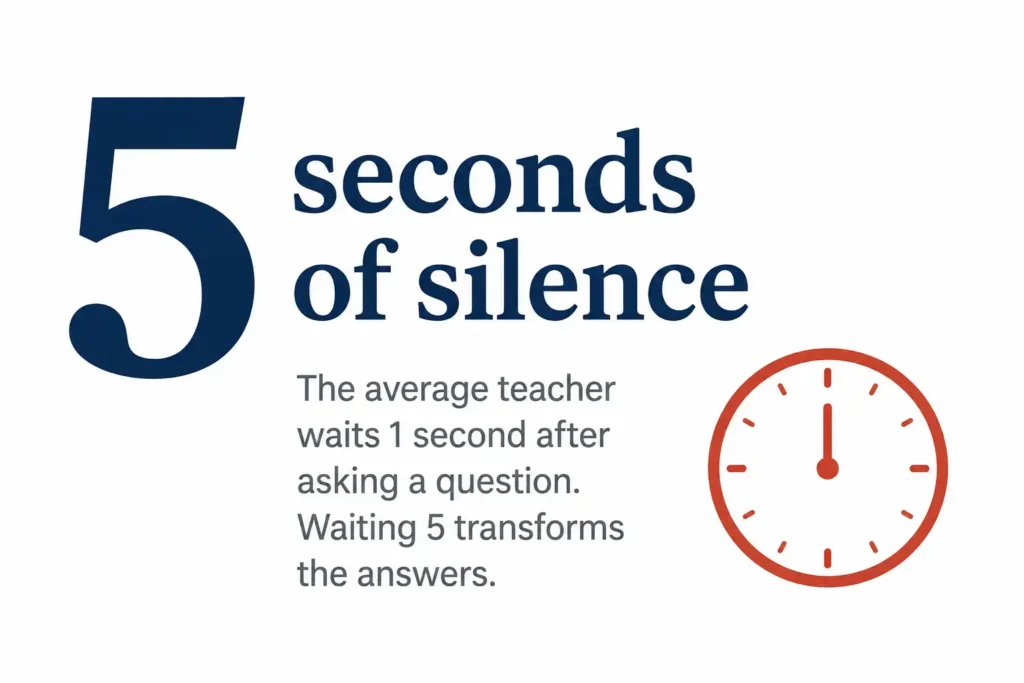
The 5 questions that turn any lesson into a thinking lesson
- “How do you know that?” Forces students to surface their evidence and reasoning, not just their conclusion. Turns an answer into an argument.
- “What would change your mind?” Tests whether a belief is held for reasons or by habit. Teaches that good thinking is updatable.
- “Can you give me an example?” Moves an abstract idea into a concrete one. If they can’t, they don’t understand it yet, and now they know.
- “What’s another way to look at this?” Breaks the first-answer reflex. Trains the mind to hold more than one possibility before settling.
- “What’s still confusing?” Makes not-knowing safe and visible. The most honest question in the room, and the one that reveals where learning actually needs to go.
Five questions. No subject required. Notice that not one of them has a single correct answer the teacher is fishing for. Every one of them opens a door rather than closing it.
How to actually use them
Knowing the questions is not the same as using them well. Three things make the difference between these questions working and falling flat.
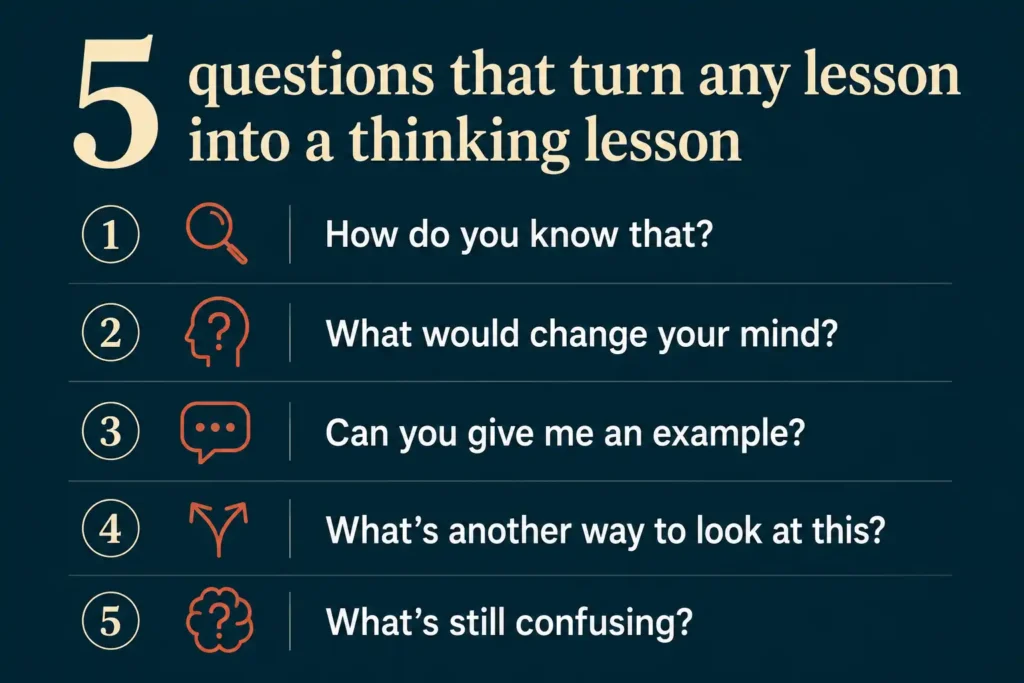
Wait after you ask. This is the single most important and most ignored teaching skill. Decades ago, a researcher named Mary Budd Rowe measured how long teachers wait after asking a question before jumping in or moving on. The average was about one second. One second is not enough time to think. When teachers were trained to wait just three to five seconds, the quality of student answers improved dramatically, more reasoning, more complete sentences, more students volunteering. So ask the question, then count silently to five. The silence will feel unbearable to you and will feel like permission to them.
Ask the whole room, not the fastest hand. The moment you take the first raised hand, every other student stops thinking. Pose the question to everyone, let them all sit in it, then call on someone, including someone who did not raise a hand. The goal is thinking distributed across the room, not a quick correct answer from the one student who always has it.
Treat a wrong answer as material, not a dead end. When a student gives a wrong or half-formed answer, the worst response is “no, anyone else?” The best is one of the five questions. “How do you know that?” “Can you give me an example?” A wrong answer, explored, teaches the whole class more than a right answer accepted.
Why this matters more than it looks
It is tempting to dismiss this as a small trick. It is not. The kind of thinking these questions demand, justifying, reconsidering, exemplifying, perspective-taking, naming your own confusion, is exactly the kind of thinking that machines cannot easily do and the world increasingly pays for.
We have written before that creativity is a skill that can be taught, not a talent you are born with. The same is true of thinking itself. It is built through practice, and the questions a student is asked, day after day, year after year, are the reps. A student asked recall questions for twelve years becomes very good at recall. A student asked “how do you know that?” ten thousand times becomes something far more valuable: a person who reasons.
The one thing to remember
You do not change a classroom by changing everything. You change it by changing the questions.
Pick one of the five tomorrow. Ask it, then wait the full uncomfortable five seconds. You will watch a room that was waiting to be told the answer slowly realise it is being asked to think instead. That shift, repeated, is the whole game.
The lesson plan was never what made students think. The questions always were.