Almost everyone has said this, or heard it said. Usually with a small shrug, as if reporting a fact about themselves, like height or eye colour. I’m just not creative.
It is one of the most widely believed ideas about the human mind. And it is wrong.
Not “wrong” in a feel-good, everyone-is-special way. Wrong in a measurable, studied, replicated-in-the-research way. Creativity is not a gift handed to a lucky few at birth. It is a set of mental habits that can be taught, practised, and improved, the same way you can improve at chess, or cooking, or writing. Decades of research point in the same direction, and most schools are still teaching as if the opposite were true.
Let us walk through what we actually know.
Where the myth came from
The belief that creativity is an inborn trait is old, and it comes from a reasonable place. We see a finished painting, a brilliant product, a beautiful piece of music, and we cannot see the years of failed attempts behind it. So we assume the creator was simply born able to do that. The struggle is invisible. The talent looks like magic.
This is the same illusion that makes us think great athletes are “naturals.” We see the final performance, never the ten thousand boring hours of practice. With creativity, the practice is even more hidden, because it happens inside someone’s head.
What the research actually found
Here is where it gets interesting. When psychologists started actually studying creativity, rather than just admiring it, the inborn-talent story fell apart.
In the 1950s and 60s, a researcher named E. Paul Torrance ran long-term studies measuring creative thinking in school children. He did not find a small group of “creative kids” and a large group of “non-creative” ones. He found that creative thinking could be measured, that it varied across all children, and crucially, that it could be developed through the right kind of teaching. His tests are still used today.
Around the same time, the psychologist J.P. Guilford broke “creativity” down into specific mental operations, things like divergent thinking, the ability to generate many possible answers to an open question, rather than one correct answer. The important word is operations. These are things the mind does, not things the mind is. And anything the mind does can be practised.
More recently, researchers have shown that creativity follows the same rules as other complex skills. It improves with deliberate practice. It improves with good feedback. It improves when you learn the techniques experts use. It is domain-specific, meaning you build it in a field by working in that field, not by sitting through a generic “creativity workshop.” None of this is how a fixed, inborn trait behaves. All of it is how a skill behaves.
The four kinds of creativity
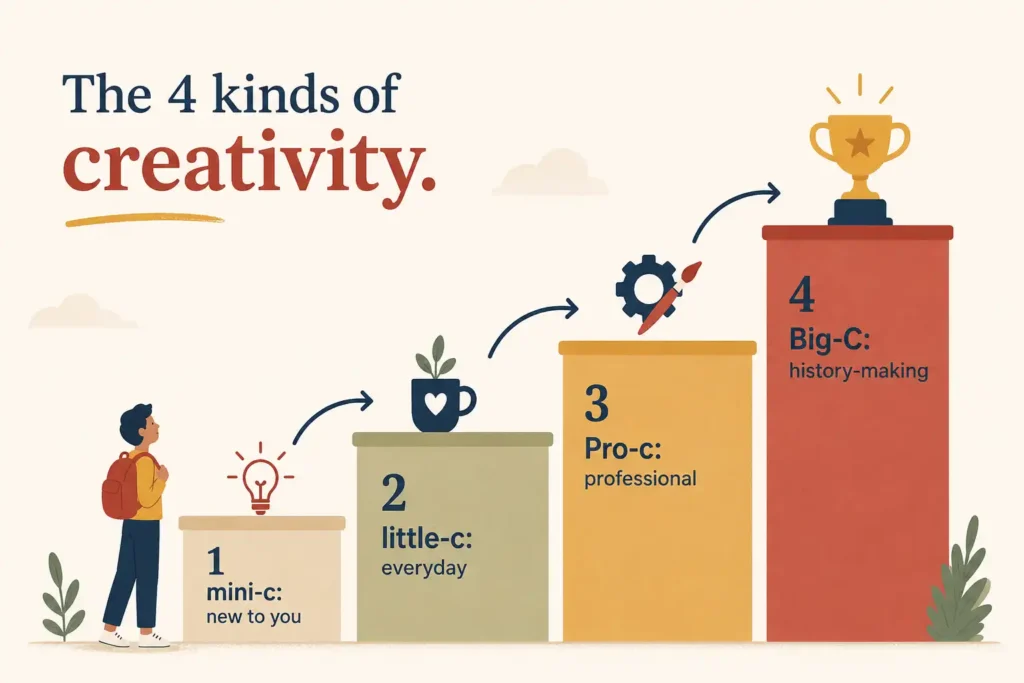
One of the most useful ideas from modern research is that creativity is not one single thing. Researchers James Kaufman and Ronald Beghetto described four levels of it, and once you see them, the “I’m not creative” myth becomes almost impossible to hold.
Mini-c is the creativity of personal learning. A child figuring out their own way to remember the multiplication tables is doing mini-c creativity. It is new to them, and that counts.
Little-c is everyday creativity. Improvising a recipe, solving a problem at home with whatever is lying around, finding a clever route through traffic.
Pro-c is professional creativity. The expert in any field who consistently produces original, valuable work.
Big-C is the rare, history-making creativity. Einstein, Tagore, the names in the textbooks.
Almost everyone who says “I’m not creative” is comparing themselves to Big-C and concluding they have none. But creativity lives on a staircase, and everyone is already standing on it. The job of education is not to find the rare Big-C genius. It is to help every student climb from mini-c upward.
Why this matters more now than ever
For most of history, you could argue about this idea without much at stake. That has changed.
We now share the world with machines that are very good at producing correct answers. An AI can recall, summarize, and follow instructions faster than any human. What it does less well, and what humans still do best, is the genuinely creative act: asking a question nobody set, connecting two unrelated things, deciding what is worth making in the first place.
Which means the one capability schools have long treated as optional, a nice extra for the “artistic” kids, is now the central thing. If creativity were truly an inborn gift, this would be terrible news, because most students would be locked out of the most valuable skill of their lifetime. But it is not a gift. It is a skill. And that changes everything about what a school is for.
So how do you actually build it?
If creativity is a skill, it has techniques, the same way writing or coding does. Here are the ones the research supports most strongly, written so you can use them tomorrow.
This is the part worth saving.
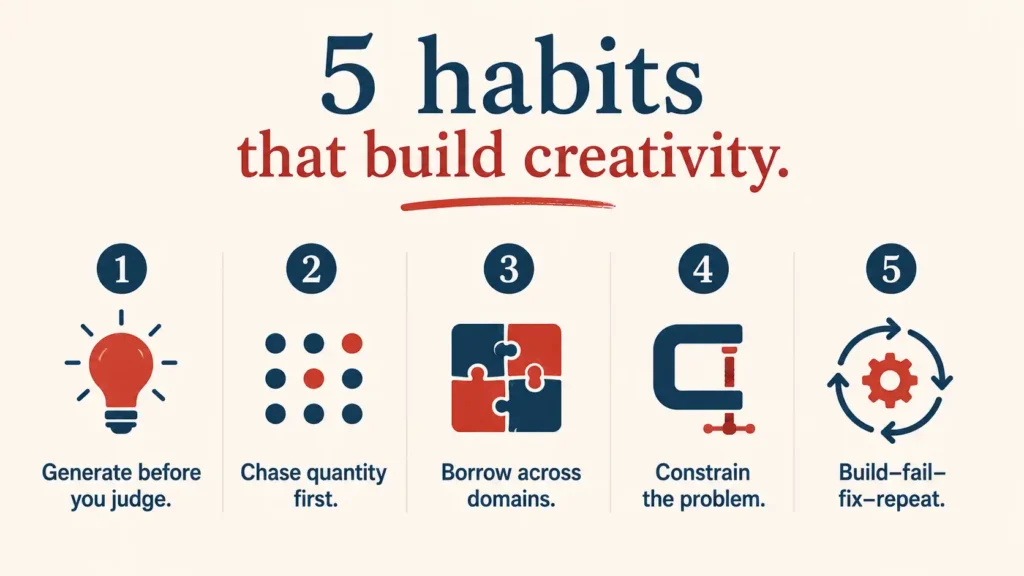
The 5 habits that build creativity
Generate before you judge. Separate the making of ideas from the evaluating of them. Most creativity dies because people criticize the first idea before producing the tenth.
Chase quantity first. More ideas reliably leads to better ideas. Aim for ten bad ones before one good one.
Borrow across domains. The most original ideas usually come from connecting two fields that don’t normally meet. Read widely, on purpose.
Constrain the problem. Total freedom paralyses. A specific limit (“build it from only what’s in this room”) forces inventive thinking.
Build, fail, fix, repeat. Creativity is iterative, not a flash of insight. The loop is the skill. Run it hundreds of times.
Notice that not one of these requires you to have been “born creative.” Every one of them is a practice. Which is the entire point.
The one thing to remember
If you teach, or you are raising a child, or you have ever quietly believed you are “just not a creative person,” remember this.
Creativity is not the lightning that strikes a chosen few. It is a muscle, built by anyone willing to do the reps. The students who look “naturally creative” are almost always the ones who were given permission to try, fail, and try again, more often than the rest. That permission is something a good classroom can give every single child.
Nobody is born uncreative. Some of us were just never taught the moves.