A Portfolio Beats a Certificate. Build One in 30 Days.
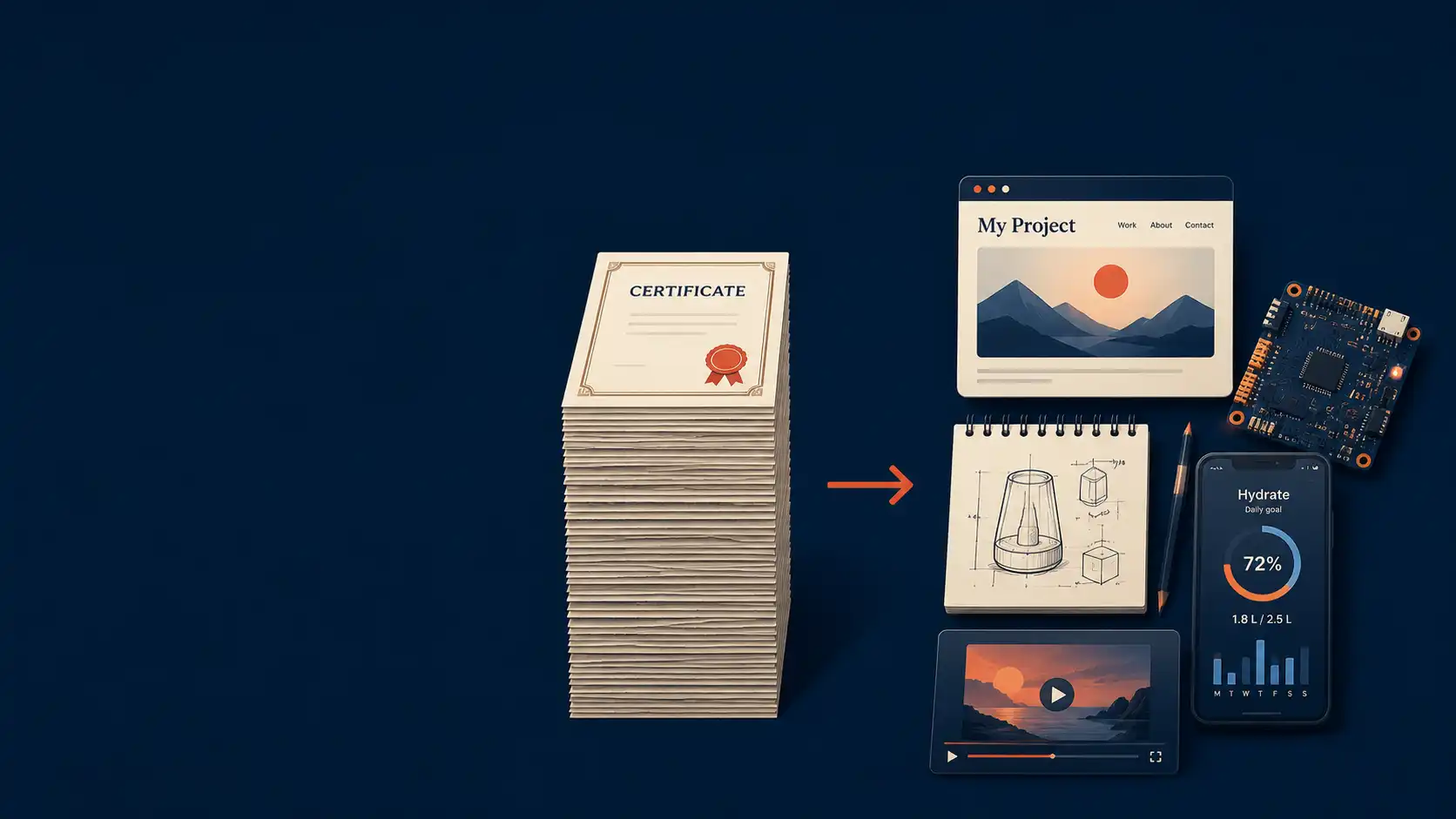
The certificate problem nobody says out loud Every student has a drawer, physical or digital, full of certificates. Course completions, workshop attendances, online specialisations, webinar participations. Each one felt like progress when it arrived. Each one represents real time and often real money. And here is the quiet truth: most of them do very little. Not because the learning was worthless, but because of what a certificate actually proves. A certificate proves you attended. It proves you were present, completed the modules, and passed whatever check the course set. What it does not prove is the one thing an employer actually wants to know: can you do the thing? A portfolio answers that question. A certificate dodges it. This is not an attack on courses. Take the course, learn the skill. But understand what the certificate at the end is and is not. It is a receipt for your attention. It is not evidence of your ability. And increasingly, the people doing the hiring know the difference. Why this shifted For most of the last century, credentials were a reasonable shortcut. There were few of them, they were hard to get, and possessing one genuinely signalled something rare. A degree or a certificate told an employer “this person cleared a high bar,” and that was useful information. Two things broke that. First, credentials became abundant. When anyone can collect fifty online certificates in a year, a certificate stops being a signal of anything rare. Abundance kills signalling value. If everyone has the badge, the badge means nothing. Second, and more importantly, the world moved toward skills-based hiring. A growing number of employers, including large ones, have shifted away from using credentials as the filter and toward asking candidates to demonstrate the actual skill. This is one of the clearest hiring trends of the past few years: companies dropping degree-and-certificate requirements and replacing them with practical assessments, work samples, and portfolios. The reason is simple self-interest. A portfolio predicts job performance far better than a certificate does, because it is job performance, just done before the job. Put those two together and the conclusion is unavoidable. In a world where credentials are abundant and employers want demonstrated ability, the thing that sets you apart is not another certificate. It is proof of work. What a portfolio actually is (and isn’t) Before the plan, clear up a common misunderstanding, because it stops a lot of people from starting. A portfolio is not a polished, professional, years-in-the-making body of masterworks. That intimidating picture is exactly what keeps people from beginning. A portfolio is simpler and humbler than that. It is just a collection of things you made, with a short explanation of how and why you made each one. That’s it. A portfolio is evidence of doing. Three small, real, finished things beat one imaginary perfect thing every time. The student who built three working, modest projects and can explain the thinking behind each will out-interview the student with ten certificates and nothing to show. And here is the encouraging part: a portfolio is buildable on a deadline. You cannot earn experience overnight, but you can produce evidence of capability in a focused month. Here is how. The 30-day plan This is the part worth saving. The plan assumes you can give it an hour or two most days. It works whether your field is coding, design, writing, teaching, marketing, electronics, or almost anything else that produces an artifact. Build a portfolio in 30 days Days 1–3: Choose your three. Pick exactly three small projects you can actually finish, each showing a different skill. Not ambitious. Finishable. A small website, a data analysis, a short film, a lesson plan you actually taught, a working circuit. Small and done beats big and abandoned. Days 4–10: Build project one. One project, start to finish, in a week. Keep it small enough that “finished” is realistic. Save your rough drafts and mistakes along the way; they become the story later. Days 11–17: Build project two. Different skill, different kind of artifact. By now you know your own pace, so calibrate the scope to actually land it in the week. Days 18–24: Build project three. Your strongest one, because you’ve warmed up. This is the project you’ll lead with. Days 25–27: Write the story behind each. For every project, write three short paragraphs: what you set out to do, how you did it, and what you’d do differently. This is the part most people skip and it is the part employers value most. The thinking is the evidence. Days 28–30: Put it somewhere public. A simple website, a GitHub, a Behance, a Notion page, a PDF, anything with a link. A portfolio nobody can see is a private diary. The shareable link is the whole point. Thirty days. Three finished things. A story behind each. A public link. That is a portfolio, and it will do more for you than the next certificate you were about to enrol in. The part that makes it actually work One principle decides whether your portfolio lands or falls flat, and it is the same principle that runs through everything we write about learning: show the thinking, not just the result. An employer looking at a finished project sees what you made. An employer reading your three paragraphs about why you made each choice, what went wrong, and what you learned, sees how you think. The second is far more valuable, because they are not hiring the project. They are hiring the mind that made it, to make the next thing they cannot yet see. This is also why a portfolio survives the AI era when a certificate does not. As we wrote in the skills that survive AI, the durable skills are judgment, reasoning, and the ability to decide what is worth making. A portfolio is the single clearest place to demonstrate exactly those skills. The project shows you can build. The story shows you can think. Together, they show the one thing no certificate ever can. A note for teachers and parents If you teach or raise students, the implication
A Portfolio Beats a Certificate. Build One in 30 Days. Read Post »