Everyone loves project-based learning. Until they try it.
Walk into almost any forward-thinking school or college today and someone will tell you, proudly, that they “do project-based learning.” It is one of the most agreed-upon good ideas in modern education. Students learn by building real things, solving real problems, working like adults actually work. Who could argue with that?
And yet, if you watch closely, a large share of project-based learning quietly does not work. The projects get made. Photos get taken. But the deep learning everyone promised somehow does not show up. Students produce something that looks impressive and walk away having learned surprisingly little.
For years, people blamed the wrong things. The students were not motivated enough. The projects were not exciting enough. The teacher needed more training, more time, more resources. But the real reason project-based learning fails is more specific than any of those, and once you see it, you cannot unsee it.
The one reason it fails
Here it is, plainly. Project-based learning fails when the project replaces the teaching instead of carrying it.
In a failed PBL classroom, the logic goes like this: “If students are doing a project, they must be learning, so my job is mostly to step back and let them discover.” The teacher hands out an exciting brief, provides some materials, and then retreats, trusting the project itself to do the teaching.
It almost never does.
What actually happens is that students, left to figure out everything at once, default to what they already know. They divide the work so the confident kids do the hard parts and the rest coast. They reach for the first idea rather than the best one. They produce something that looks like learning, a working model, a slide deck, a video, while the actual concepts the project was meant to teach slip past untouched. The artifact gets built. The understanding does not.
This is not a small failure mode. It is the dominant one.
Why “just let them discover” doesn’t work
There is a comfortable belief in education that children learn best when left to explore freely, with minimal instruction. It feels right. It fits our romantic picture of the curious child inventing the world for themselves.
The research is not kind to it.
One of the most cited papers in the field, by Paul Kirschner, John Sweller and Richard Clark, reviewed decades of evidence and concluded bluntly that minimally guided instruction does not work well, especially for learners who are still novices in a subject (their 2006 paper is here). The reason is about how memory works. A beginner’s working memory is easily overloaded. Drop them into a complex open project with no structure and most of their mental effort goes into just coping with the chaos, leaving little capacity left for the actual concept you wanted them to grasp.
This does not mean projects are bad. It means projects without structure are bad. And those are very different claims.
The fix: scaffolding, not stepping back
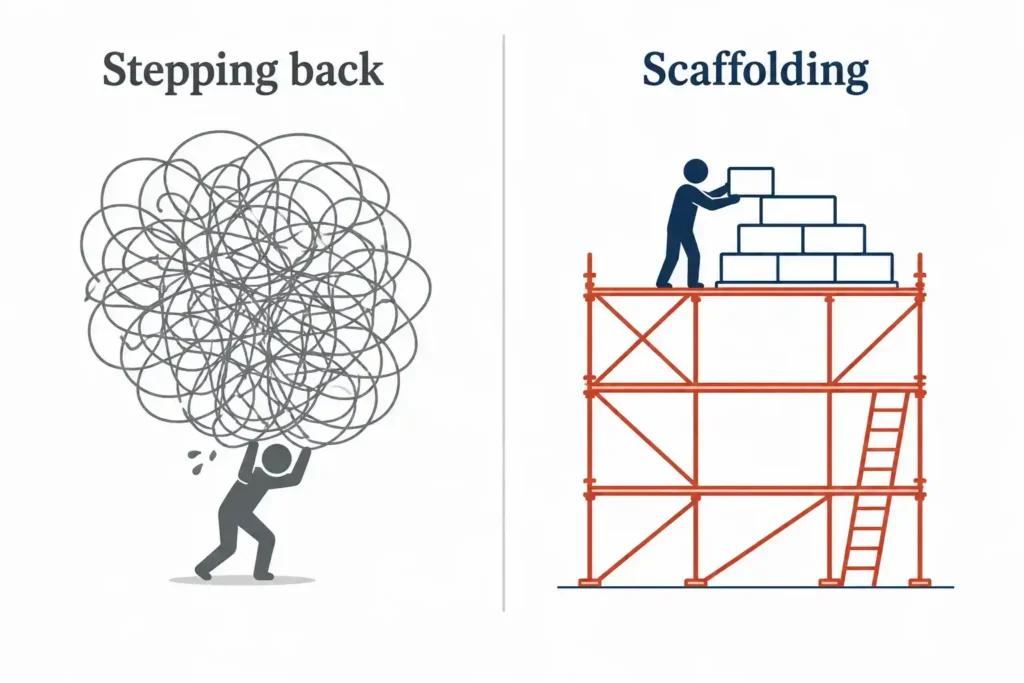
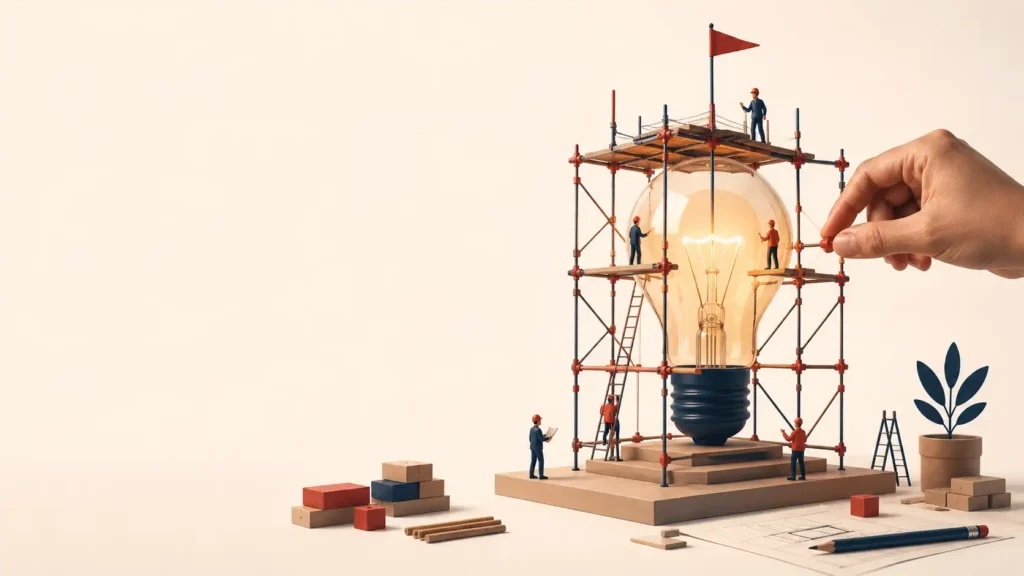
The fix is a single shift in how the teacher sees their role. In failed PBL, the teacher steps back and lets the project teach. In effective PBL, the teacher stays fully present and scaffolds the project, building temporary supports that hold the student up until they can stand on their own.
Scaffolding is exactly what it sounds like. When you construct a building, you put up scaffolding to support the structure while it is being built, then remove it once the building can stand. Good teaching does the same with understanding. You provide structure early, when the student is fragile in the concept, and you withdraw it gradually as they grow stronger.
In a project, scaffolding looks like this:
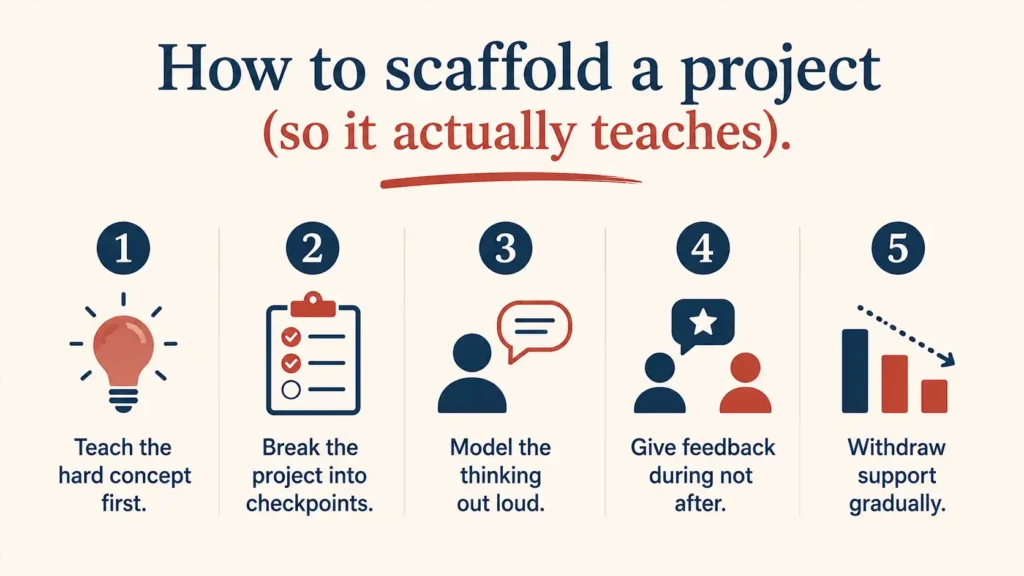
- You teach the hard concept directly, first. Do not hope the project will deliver it. Teach it, then let the project apply it.
- You break the project into checkpoints. Not one big reveal at the end, but a sequence of smaller milestones, each with feedback.
- You model the thinking out loud. Show students how an expert approaches the messy middle, the part where most projects stall.
- You give feedback during, not after. Feedback at the end is a grade. Feedback in the middle is teaching.
- You withdraw support deliberately as students get stronger, so that by the final project of the year they genuinely are working independently, because you built them up to it.
This is the difference between a project that teaches and a project that merely happens.
Why this connects to everything else
There is a deeper point here, and it links directly to something we have written about before: that creativity is a skill, not an inborn talent. The same logic applies. We do not expect students to become creative by simply being told “be creative.” We do not expect them to learn through projects by simply being handed a project. In both cases, the magic word is taught. The skill has to be built, deliberately, with structure, by a teacher who stays in the room.
The research backs the upside, too. When project-based learning is done well, with proper scaffolding, the results are strong. Large studies, including recent work summarised by PBLWorks and the Lucas Education Research foundation, show meaningful gains in understanding and engagement, across different subjects and student backgrounds. The method is not the problem. The unsupported version of the method is.
The one thing to remember
If your school or college “does project-based learning” and it is not producing the depth you hoped for, do not abandon the projects. Look instead at one thing: is the teacher stepping back, or scaffolding?
A project is not a substitute for teaching. It is a vehicle for it. The teacher who understands that difference can make project-based learning extraordinary. The teacher who does not will keep producing impressive-looking artifacts and wondering why the learning never seems to stick.
The projects were never the point. The scaffolding around them always was.