The nine pages that built ChatGPT
In June 2017, eight researchers at Google published a paper with a slightly cheeky title: “Attention Is All You Need.” It was about machine translation, a narrow and unglamorous corner of AI. It was nine pages long. It did not announce itself as the most important paper of the decade.
It was the most important paper of the decade.
Almost every AI system you have heard of, ChatGPT, Claude, Gemini, the tools writing code and drafting emails and answering homework, is a direct descendant of this one paper. The architecture it introduced is called the Transformer. That is the “T” in GPT. If you want to understand why AI suddenly got good around 2023, the story starts here, in 2017, with a paper most of the world never read.
Here is what it actually said, without the maths degree.
The problem: AI used to read one word at a time
To see why the paper mattered, you have to see what it replaced.
Before 2017, the best language models read text the way you might read through a keyhole: one word at a time, left to right, trying to hold everything that came before in a kind of running memory. These were called recurrent networks. They worked, but they had two deep problems.
First, they were slow. Because each word had to wait for the previous word to be processed, you could not do the work in parallel. The model was stuck reading in single file.
Second, they were forgetful. By the time the model reached the end of a long sentence, the beginning had faded. Ask it to connect a word at the end of a paragraph to something near the start, and the thread had often gone cold. The memory leaked.
Both problems came from the same root: the model processed words in sequence, one after another, carrying a fragile memory forward. What if it did not have to?
The big idea: let every word see every other word at once
Here is the move that changed everything. Instead of reading in order and trying to remember, let every word look directly at every other word in the sentence, all at the same time, and decide for itself which ones matter.
That is attention. More precisely, self-attention.
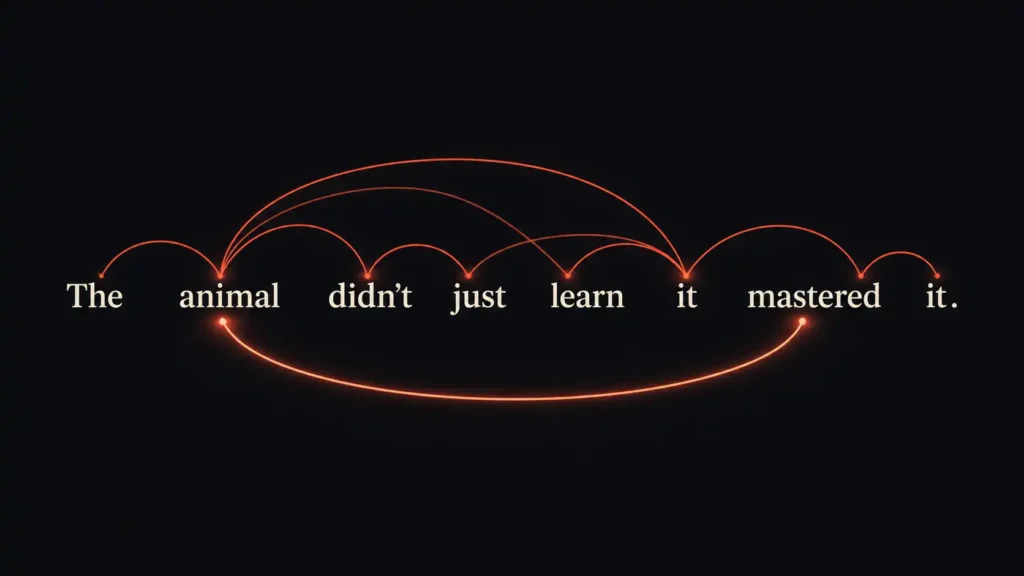
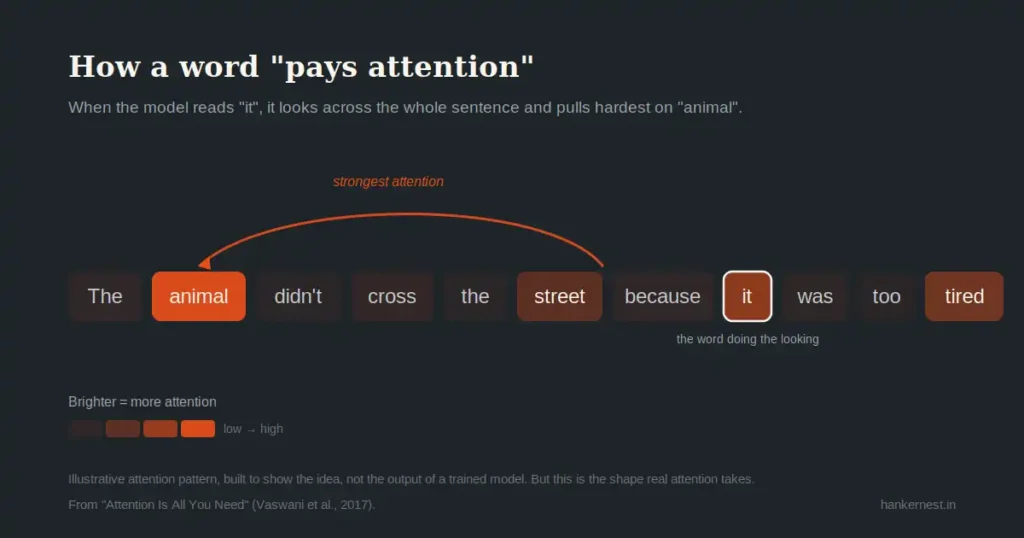
Take the sentence in the demo above: “The animal didn’t cross the street because it was too tired.” What does “it” refer to? You know instantly, without thinking, that “it” means the animal, not the street. That little act of connecting “it” back to “animal” across a gap of several words is exactly what attention does. The model lets “it” reach across the whole sentence and pull hardest on the word that matters most to it.
No reading in single file. No fading memory. Every word, connected to every other word, in one parallel step. Click around the demo above and you are watching this happen: each word casts a different web of attention over the rest of the sentence.
How attention actually works: the library analogy
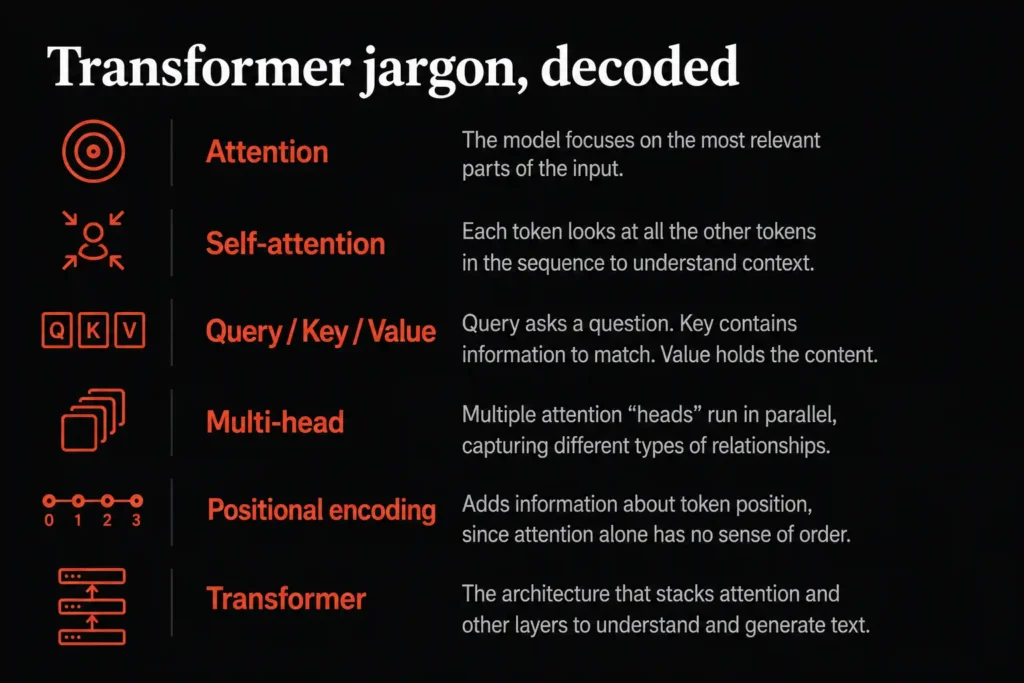
So how does a word “decide” what to pay attention to? This is the part with the famous three letters: Q, K, V. They sound intimidating. They are not.
Every word produces three things:
- A query (Q): what am I looking for?
- A key (K): what do I offer?
- A value (V): the actual content I carry.
Think of a library. You walk in with a request slip, that is your query. Every book has a label on its spine, that is its key. You compare your slip against all the labels, and the ones that match best are the books you want. You then pull those books and read their contents, the values, paying most attention to the books that matched your request most closely.
That is all attention is. Each word’s query is compared against every word’s key. Strong matches get high scores. Those scores become weights. And the word builds its new understanding as a blend of everyone’s values, weighted by how well they matched.
The paper writes this as one line: softmax(QK^T / √d_k)V. Do not let it scare you. Read left to right it just says: score every pair (QK^T), shrink the numbers so they behave (√d_k), turn them into clean weights that add up to one (softmax), then use those weights to blend the values (V). Score, normalise, blend. That is the whole engine.
Multi-head attention: several perspectives at once
One pass of attention captures one kind of relationship. But language has many at once. There is grammar (which verb goes with which subject), there is reference (what does “it” point to), there is topic, tone, and more.
So the Transformer does not run attention once. It runs it several times in parallel, each with its own set of queries, keys and values. These are the “heads.” One head might learn to track grammatical agreement, another might track which pronoun refers to what, another might follow the topic. Then their findings are combined.
Picture several expert readers each marking up the same sentence for a different thing, then merging their notes into one richer understanding. That is multi-head attention, and it is why the architecture captures the layered, overlapping meaning that real language carries.
Why it actually mattered: it could be parallelized
Now the deep reason this paper won, the reason that matters more than any single clever mechanism.
Because attention looks at all words at once instead of one at a time, the whole computation can be done in parallel. And parallel computation is exactly what modern hardware, the GPUs that power AI, is built to do. The old sequential models left most of that hardware idle, waiting in line. The Transformer could light all of it up at once.
That unlocked scale. You could train on far more text, far faster, than ever before. And it turned out that when you make these models bigger and feed them more, they keep getting better, an effect that the entire current AI boom is built on. None of that scaling would have been practical with the old, sequential architecture.
The title was a thesis statement. You do not need recurrence. You do not need the older convolutional tricks. Attention, done at scale, is all you need. It sounded like a boast in 2017. It reads like a prophecy now.
What it became
The paper was about translation. Within a year, researchers realised the architecture was far more general. In 2018 came BERT, which used the Transformer to understand language, and the GPT series, which used it to generate language. The “T” in both names is Transformer. Everything since, every large language model you can name, sits on this foundation.
And it did not stop at text. Attention now powers models that handle images, audio, and even protein folding. One architecture, proposed in a modest nine-page translation paper, turned out to be the blueprint for a decade of AI.
The one thing to remember
The shift the paper made is simple enough to hold in one sentence. The old way: read in order, try to remember. The new way: look at everything at once, and weigh what matters.
That move, from sequence to attention, is the quiet hinge the entire current AI era turns on. Eight researchers, nine pages, a slightly cheeky title. They were not exaggerating. Attention really was all we needed.
References and further reading
The paper this post is about:
- Vaswani, A., Shazeer, N., Parmar, N., Uszkoreit, J., Jones, L., Gomez, A. N., Kaiser, Ł., & Polosukhin, I. (2017). Attention Is All You Need. arXiv. arxiv.org/abs/1706.03762
The key descendants we mentioned:
- Devlin, J., Chang, M.-W., Lee, K., & Toutanova, K. (2018). BERT: Pre-training of Deep Bidirectional Transformers for Language Understanding. arXiv. arxiv.org/abs/1810.04805
- Radford, A., Narasimhan, K., Salimans, T., & Sutskever, I. (2018). Improving Language Understanding by Generative Pre-Training. (The first GPT paper.) cdn.openai.com/research-covers/language-unsupervised/language_understanding_paper.pdf
If you want one accessible explainer to go deeper:
- Alammar, J. (2018). The Illustrated Transformer. jalammar.github.io/illustrated-transformer